Fernando Angulo, Senior Market Research Manager at Semrush, an Adobe company
A useful GEO report helps the client decide what to change. It separates completed work, brand presence, visible sources and documented commercial contribution.
GEO, Generative Engine Optimization, describes work directed at the presence of content and brands in generative answers. For the executive approving a budget, the question is specific: what did we observe, what explanation does the evidence support and what should happen in the next cycle?
My proposed Four-Layer GEO Scorecard separates execution, visibility, evidence and business. Each layer has a question, a record and a boundary. Together, they support both management review and the team responsible for acting.
The client needs a decision they can defend
A dashboard can show more mentions while sales finds no new contacts attributable to the program. Both records can be correct. The reporting failure occurs when the first is presented as proof of the second.
Marketing needs to know where the brand appears and which interpretation is defensible. Sales needs evidence of origin in contacts and opportunities. Finance needs to distinguish cost, work and documented results. One blended score makes those decisions difficult to review.
Open the meeting with a decision: “The brand appears in definition questions but is missing from comparisons. We will review the evidence buyers need to choose a supplier.” This is a hypothetical reporting example, not an observed client result.
The remaining report should make that statement inspectable. Show the panel, responses, sources and comparison conditions. If the evidence does not yet support an intervention, the next action can be to complete measurement.
A mention, a citation and a visible link serve different purposes
A mention occurs when the answer names the brand. A recommendation requires the answer to present it as a suitable option. A citation records a visible reference with an identifiable source and exact URL.
A link in a secondary panel can provide context without supporting a specific assertion in the answer. Record it as a visible related link when that is what you observed. A server-log access records crawling. Internal retrieval requires a verifiable trace the product actually exposes.
Define these terms before the first report and use them consistently. Keep the response, capture, URL, date and source classification. This lets the client inspect the diagnosis when someone challenges the conclusion.
Four layers preserve the evidence behind the decision
| Layer | Record to keep | Decision it supports |
|---|---|---|
| Execution | Published changes, owners, dates and checks | Whether the agreed work was completed |
| Visibility | Mentions, recommendations, prominence and accuracy | Where the brand appears or fails by intent |
| Evidence | Exact cited URLs, source classes and supported claims | Which proof supports the answer and what is missing |
| Business | Referrals, key events and CRM evidence | Which commercial contribution can be documented |
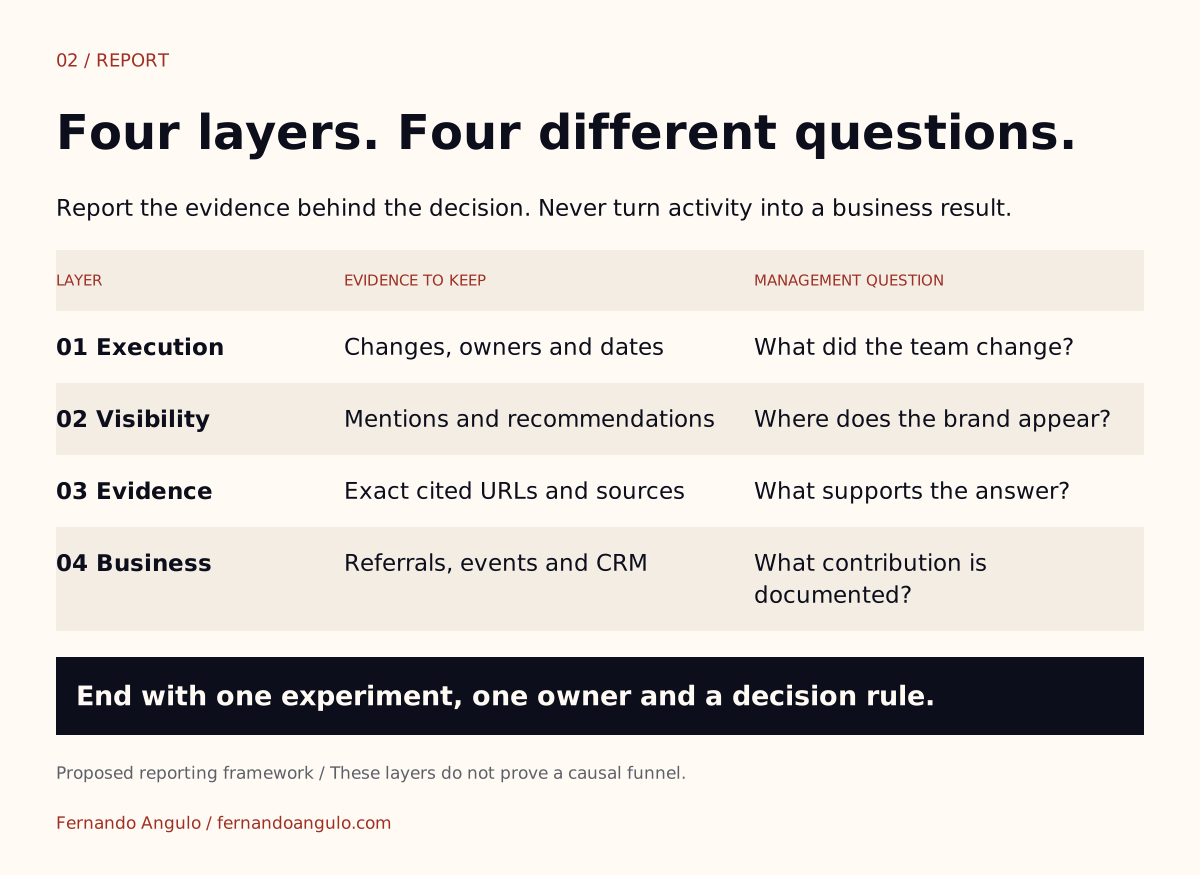
Created in Figma for this article. This is a proposed reporting framework, not a causal funnel or a set of client results.
For execution, record the evidence or page changed and why. For visibility, separate platforms and intents. For evidence, preserve exact URLs and distinguish brand-controlled, affiliated and external sources. For business, define an assisted contact and assign someone to review that classification.
One intervention can produce different signals. Correcting a page could improve factual accuracy without changing recommendations. Its usefulness to the buyer deserves review even when a general score remains flat.
The denominator explains what you measured
Use valid responses as the denominator for panel rates. Record failed and uncollected runs separately. Hold questions, conditions and repetition counts comparable before reporting movement over time.
Entirely illustrative example: a panel contains 60 valid answers. The brand appears in 21, its domain is cited in nine, and both occur in six. Eight answers present the brand as a suitable option.
| Proposed measure | Example calculation | Result |
|---|---|---|
| Mention share | 21 / 60 | 35% |
| Owned citation rate | 9 / 60 | 15% |
| Owned support among mentions | 6 / 21 | 28.6% |
| Recommendation rate | 8 / 60 | 13.3% |
The third measure asks which answers mentioning the brand also cite its domain. Its denominator differs because its question differs. These values describe the example and establish no industry benchmark.
Present counts alongside percentages when reviewing change. Show whether missing signals concentrate in a platform or intent. Numbers should help select an intervention rather than hide variability behind a decimal.
Traffic and CRM complete part of the story
Google Analytics documentation, checked October 11, 2026, defines an AI Assistant channel for recognized referrers and excludes AI Overviews and AI Mode. This measures identified visits, not all exposure without a click.
The Search Console generative AI report, checked on the same date, covers link impressions in AI Overviews and AI Mode. Retain its aggregation rules and dimensions when interpreting the data.
These records answer different questions from an answer panel. They do not reconstruct the conversation before a visit. Connect each signal to its supporting record and avoid adding different units as if they represented one audience.
In CRM, define “AI-assisted”: an identified referrer, a contact’s declaration or another verifiable record. Preserve provenance and let sales confirm or reject the classification. Someone might see an answer and later arrive through another route; without evidence, the origin remains unknown.
Six slides can structure the monthly review
- Executive decision: what changed, what it implies and what you propose.
- Scope and method: questions, platforms, settings, repetitions and missing runs.
- Visibility: mentions, recommendations and accuracy by intent.
- Evidence map: URLs, source classes and missing proof.
- Business: referrals, events and documented CRM contribution.
- Next experiment: intervention, owner, date and decision rule.
Cadence depends on the work cycle and observation volume. A monthly review can organize the program; a long sales cycle needs an appropriate commercial window. Keep definitions stable even when another definition would produce a more favorable report.
The next intervention can be small
If the brand appears with an incorrect description, correct factual evidence before expanding the panel. If it disappears in comparisons, review selection criteria, conditions and relevant cases. If commercial evidence is incomplete, improve Analytics and CRM definitions before attributing revenue.
As a proposed experiment, an agency could revise one comparison page, log the change and repeat the unchanged panel. The review would inspect the expected signals while retaining alternative explanations. This produces inspectable evidence, not a performance promise.
End the meeting with an actionable choice: continue, correct, finish collection or stop an activity that produces no useful evidence. Clear reporting also prevents unnecessary work.
A decision record to take into the meeting
Complete this sentence: “We observed [signal and denominator] in [intent/platform]. We will change [one page or evidence item], owned by [person], by [date]. At the next review we will [continue, change, or stop] based on [predefined evidence].” Attach the response archive and keep commercial evidence separate. This is a proposed working template.
Frequently asked questions
What is the main KPI in a GEO report?
It depends on the decision under review. Keep brand presence and owned citations separate, with counts and denominators, and add commercial signals when documented.
Can mentions be combined across platforms?
You can present a descriptive total with its composition. Retain platform and setting breakdowns so unequal coverage does not distort interpretation.
Is a citation more valuable than a mention?
They answer different questions. A citation records a visible source and a mention records brand presence; neither guarantees recommendation or purchase.
Should technical failures count as zero?
Record them as failures. Zero requires a valid answer in which the observed signal is absent.
How should the report connect to revenue?
Use referral records, events and documented CRM criteria. Describe contribution where evidence supports it and reserve causal claims for designs capable of establishing them.
What if the panel does not change?
Check method stability, intervention usefulness and collection completeness. Continuing, changing or stopping the experiment can be reasonable depending on the observations.
Use the four layers at your next review and close with one experiment, one owner and one decision rule. That gives the client something usable in the next management conversation.
 FA
FA