Personal research by Fernando Angulo. Preliminary analysis of the corpus frozen on September 22, 2026. The main sample contains 867 postings classified as current at that cutoff, from 701 employers. A separate historical cohort contains 136 postings. Current describes the cutoff classification; it does not guarantee a vacancy remains open today.
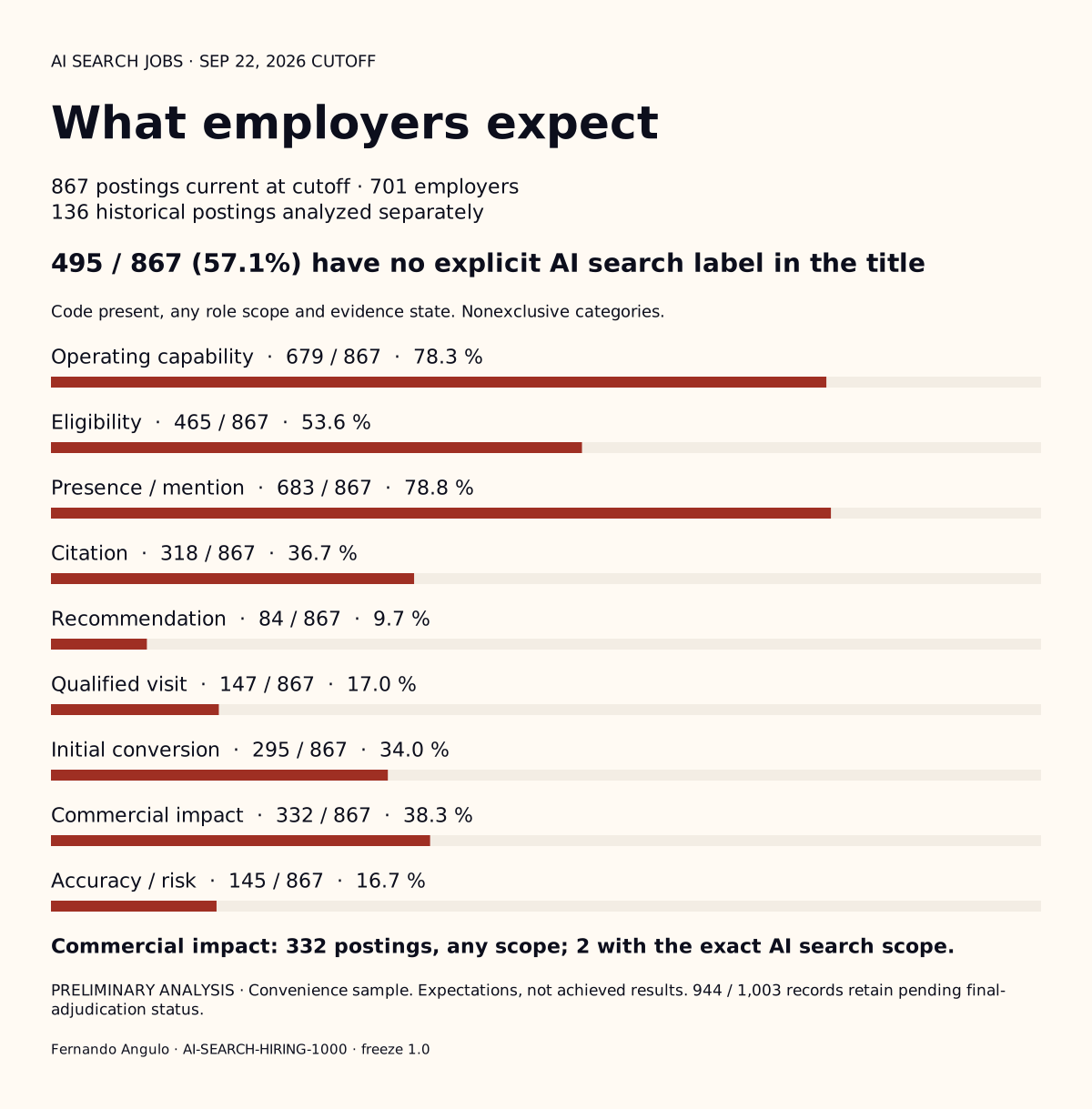
AI search work appears beyond job titles carrying its labels. 495 of the 867 current postings (57.1%) contain no explicit AI search label in their title, despite meeting the functional inclusion criteria. The remaining 372 (42.9%) match the study's title dictionary.
My reading is that searching only for a GEO Manager misses some of the work employers in this sample describe. GEO means Generative Engine Optimization; AEO means Answer Engine Optimization. The function can also sit within SEO, content, growth, or marketing leadership. This finding describes the corpus, not the size of the labor market.
The second signal is the distance between visibility and business impact. Presence is coded in 683 current postings and commercial impact in 332. However, only two of those 332 have a commercial-impact code labeled with the exact AI search scope. Much of the commercial language belongs to the wider role. Assigning revenue expectations and demonstrating revenue attributable to AI search are different observations.
The sample: from 1,466 records to 867 postings in the main analysis
The unit is a unique posting or requisition, not a URL, location, hire, or employed person. A multi-location posting counts once. Deduplication prioritizes employer and requisition identifier, supported by canonical URLs and checks of title, location, and content.
| Frozen registry stage | Count | Use |
|---|---|---|
| Physical records collected | 1,466 | Includes aliases and candidates not admitted |
| Source aliases removed | 26 | Another representation of the same unit |
| Candidate units after removing aliases | 1,440 | Discovery universe |
| Core postings admitted | 1,003 | 867 current and 136 historical |
| Main cohort: official current source at cutoff | 867 | Main denominator |
| Historical cohort: official historical evidence | 136 | Separate denominator |
| Candidates awaiting resolution | 344 | Outside the results |
| Exploratory adjacent records | 85 | Outside the core |
| Excluded records | 8 | Outside the core |
Discovery was targeted and multilingual, combining GEO, AEO, AI Search, and AI Visibility terms with conventional titles. Sources included employer pages and recruitment systems such as Greenhouse, Lever, Ashby, Workable, and SmartRecruiters. Directories and intermediaries helped discover candidates; they did not replace primary evidence for inclusion.
A posting had to describe substantive work on commercial generative search: visibility, inclusion, citations, recommendations, or activities enabling them. Generic AI references, model-engineering positions without this function, and geospatial uses of GEO were insufficient. The protocol distinguishes official current sources, official historical sources, and discovery sources.
This is a convenience sample, shaped by queries, languages, access, and source recovery. It is neither a probability sample nor a census. All eight files match their frozen SHA-256 hashes. I recalculated the tables from the frozen registry. The sample register, cohort tables, and methodology make the calculation reviewable.
Titles: 57.1% fall outside a search based only on explicit labels
| Title classification | Current, n = 867 | Historical, n = 136 |
|---|---|---|
| Explicit term from the AI search dictionary | 372 (42.9%) | 58 (42.6%) |
| No explicit dictionary term | 495 (57.1%) | 78 (57.4%) |
This is a lexical classification. It recognizes GEO, AEO, AIO, generative engine, answer engine, AI Search, AI Visibility, and LLM Visibility according to the published regular expression. It does not measure specialization or seniority. No explicit term means that the title does not match this dictionary, not that the posting has no AI work.
The proportions are similar across cohorts, but these cohorts are not comparable time windows. The table describes two groups of recovered postings; it does not establish a change in title usage.
For a marketing leader, the practical implication is to inventory tasks before titles. An employer can assign AI search work without creating a dedicated position. The sample documents that coexistence, without establishing the dominant organizational structure across the market.
Nine dimensions of work and expectations
Each posting can receive several codes, so percentages do not add to 100%. The table counts each code once per posting, across any role scope and any of four evidence states: responsibility, target, metric, or required prior result. Not every code is a task, and not every code is specific to AI search.
| Coded dimension | Current, n = 867 | Historical, n = 136 |
|---|---|---|
| O0. Operating capability: processes, teams, governance | 679 (78.3%) | 76 (55.9%) |
| O1. Eligibility: crawling, retrieval, interpretation | 465 (53.6%) | 67 (49.3%) |
| O2. Presence or mention | 683 (78.8%) | 113 (83.1%) |
| O3. Citation or explicit attribution | 318 (36.7%) | 60 (44.1%) |
| O4. Selection or recommendation | 84 (9.7%) | 17 (12.5%) |
| O5. Qualified visit | 147 (17.0%) | 24 (17.6%) |
| O6. Initial conversion | 295 (34.0%) | 45 (33.1%) |
| O7. Commercial impact | 332 (38.3%) | 41 (30.1%) |
| O8. Accuracy, trust, and risk | 145 (16.7%) | 34 (25.0%) |
Eligibility includes making content crawlable, retrievable, or interpretable. Presence means the brand appears; citation requires explicit attribution. Recommendation involves selection or comparison. Initial conversion can be a signup, inquiry, or purchase. Commercial impact covers pipeline, revenue, retention, or economic efficiency.
Restricting the count to the responsibility evidence state leaves 679 current postings with operating capability and 453 with eligibility. Presence falls to 22 and citation to eight because these codes appear mainly as metrics or targets. Describing all 683 presence-coded postings as execution responsibilities would erase that distinction.
I also checked employer concentration. Counting an employer once per dimension, presence appears in 571 of 701 employers (81.5%), operating capability in 559 (79.7%), eligibility in 396 (56.5%), and citations in 289 (41.2%). This sensitivity check prevents employers with multiple requisitions from explaining the pattern alone. The denominator still consists of employers found through targeted discovery.
Scope changes the interpretation of commercial expectations
The next table applies the exact scope filter `ai_search`. It excludes general-role codes, combined organic-and-AI-search labels, and other unnormalized scopes. This is a conservative filter, not a complete measure of every AI-related reference.
| Dimension | Any role scope | Exact AI search scope | Denominator |
|---|---|---|---|
| Presence | 683 (78.8%) | 681 (78.5%) | 867 current postings |
| Citation | 318 (36.7%) | 318 (36.7%) | 867 current postings |
| Qualified visit | 147 (17.0%) | 36 (4.2%) | 867 current postings |
| Initial conversion | 295 (34.0%) | 15 (1.7%) | 867 current postings |
| Commercial impact | 332 (38.3%) | 2 (0.2%) | 867 current postings |
My interpretation is that the sample documents visibility more clearly than AI-specific commercial attribution. That reading combines employer language with coding decisions. It does not show that employers lack attribution or that visibility cannot contribute to sales. An absent code in a posting does not establish an absent practice.
Across the 1,003 core postings, no record contains an achieved commercial result in the field dedicated to that evidence. The corpus contains expectations, metrics, and experience requirements, not observed hiring or business outcomes. It studies how work is defined; it does not demonstrate its return.
Four postings show how the work fits together
These cases illustrate cutoff coding, without representing their sectors. Links point to the original sources. Some no longer return readable text; the cutoff evidence remains referenced in the registry.
Stripe, Head of AEO & SEO. The posting combines team leadership, architecture, content, and measurement. It distinguishes visibility, citations, signups, and economic impact from organic channels. The mandate requires coordination across product, engineering, and marketing; the posting provides no achieved results. The Stripe source remained readable during this review.
Aiven, Technical AEO Manager. The role combines retrievable content structure, a prompt panel, citations, and connections to commercial data. It also asks for attribution caveats. It illustrates why a technical function needs access to documentation, engineering, and sales. The Aiven posting remained readable during the review.
Virgin Voyages, Sr. Discoverability (GEO/SEO) Manager. Frozen coding records cross-functional strategy, technical readiness, presence, citations, and recommendation for travel decisions. Business objectives carry a general-role scope. The original source returned no verifiable text during this review; this case comes from the frozen registry.
Smarsh, Generative AI & SEO Strategist. The registry records structured data, entities, visibility, and citations alongside MQLs and pipeline for the wider organic role. The useful distinction is between AI search diagnosis and overall commercial contribution. The original source could not be recovered during this review; I do not claim the vacancy remains open.
Review coverage and the remaining adjudication gap
The review register lists all 1,003 core postings as completing materiality review and second outcome coding. Coder identifiers document AI-assisted work. This is not independent human expert peer review, and no inter-coder agreement measure such as kappa is recorded.
One discrepancy remains visible: 944 records retain a second-coding-complete, final-adjudication-pending status; 59 have completed-adjudication statuses. Of the pending records, 844 are current and 100 historical. Reproducing the totals validates the arithmetic; it does not resolve the validity of every label.
These tables are therefore preliminary results from the frozen registry. A final report requires reconciliation of these statuses with final decisions and review of the affected coding evidence. Skills, compensation, and seniority frequencies also require sufficient normalization and coverage before their denominators can support publication.
What a CMO can decide from this evidence
The corpus helps define a mandate. My recommendation is to separate four responsibilities: maintain retrievable and accurate evidence, observe presence and citations, coordinate interventions, and evaluate commercial connections with their attribution limits.
To prepare the mandate, record five fields: buyer decision, evidence to maintain, specialists and access required, signals to observe, and the result criterion. Compare them with existing team capabilities before choosing to hire, train, or reassign.
A job description should state who can act on documentation, content, engineering, and data. If revenue is an expectation, provide the instrumentation and explain what will count as evidence of a result. A visibility screenshot does not settle that requirement.
The topic ownership map helps identify the questions and evidence a brand should cover. The reporting model separates observation, interpretation, and business outcomes. Together they help a team decide whether to hire, train, or redistribute work. These 867 postings provide design references; they do not automatically justify another vacancy.
Frequently asked questions
Does the sample contain 1,003 open vacancies?
No. It contains 867 classified as current at the September 22, 2026 cutoff and 136 historical postings. It is not a count of 1,003 vacancies open today or 1,003 hires.
How many titles carry an explicit AI search label?
372 of 867 current postings, or 42.9%, match the published dictionary. The other 495 meet the functional inclusion criteria without matching that dictionary in their title.
Which dimensions are most frequent?
Presence, 683 of 867 (78.8%), and operating capability, 679 (78.3%). Codes combine responsibilities, targets, metrics, and required experience, so their evidence state matters.
Do these postings demonstrate commercial return from AI search?
No. They document expectations. The achieved-commercial-results field is empty across all 1,003 core postings.
Does counting employers change the pattern?
Presence appears in 571 of 701 employers (81.5%), operating capability in 559 (79.7%), eligibility in 396 (56.5%), and citations in 289 (41.2%). The pattern is not explained solely by employers with several requisitions.
Is this a final study reviewed by human experts?
No. It is a reproducible preliminary analysis with AI-assisted review and pending adjudication statuses that must be reconciled before finalizing the report.
Before approving the next vacancy, complete the responsibility, access, and results-evidence map with your team. That conversation will make the title you choose more useful.
 FA
FA