Respuesta rápida:El aumento de capacidades significa que la IA absorbe capas específicas de tareas dentro de un rol, tareas repetitivas, basadas en reglas y de procesamiento de datos, mientras el trabajador redirige el tiempo recuperado hacia un trabajo estratégico, relacional y que exige criterio. El desplazamiento de la fuerza laboral significa que la IA elimina el rol por completo. En América Latina, la evidencia apunta de forma abrumadora al aumento de capacidades. La región enfrenta una escasez de talento, no un exceso: la IA está resolviendo la escasez, no creándola.
La escasez de talento de la que nadie habla
Toda conversación importante sobre la IA y el empleo en América Latina parte de una premisa falsa: que la región tiene un exceso de trabajadores que la IA ahora desplazará. La premisa invierte la restricción real. Los mercados laborales de América Latina se caracterizan por una severa escasez de talento calificado, en tecnología, ingeniería, finanzas, operaciones y gestión, no por un exceso.
Entre Brasil, México, Colombia y Argentina, la brecha de talento tecnológico asciende a cientos de miles de vacantes sin cubrir cada año. Las empresas de estos mercados compiten con agresividad por el mismo grupo de candidatos calificados, lo que encarece los salarios y alarga los ciclos de contratación. El problema no es que haya demasiados trabajadores para los puestos disponibles, sino que hay muy pocos trabajadores calificados para los puestos que necesitan cubrirse.
Este contexto importa porque replantea por completo lo que hace la IA cuando entra en una organización latinoamericana. Un sistema de IA que vuelve un 30 % más productivo a un analista calificado en un mercado con exceso de talento genera presión de desplazamiento. Un sistema de IA que vuelve un 30 % más productivo a un analista calificado en un mercado donde no puedes contratar a un segundo analista calificado es una expansión de capacidad. La aritmética es idéntica. La interpretación estratégica es la opuesta.
América Latina está en el segundo caso. La IA no llega a una economía con exceso de mano de obra; llega a una economía desesperada por capacidad. Las organizaciones que entienden esta distinción están desplegando la IA como infraestructura de amplificación, no como una herramienta de reducción de plantilla. Las que aún la plantean de esta última forma están resolviendo el problema equivocado.
El alza de productividad del 8 %: qué absorbe realmente la IA
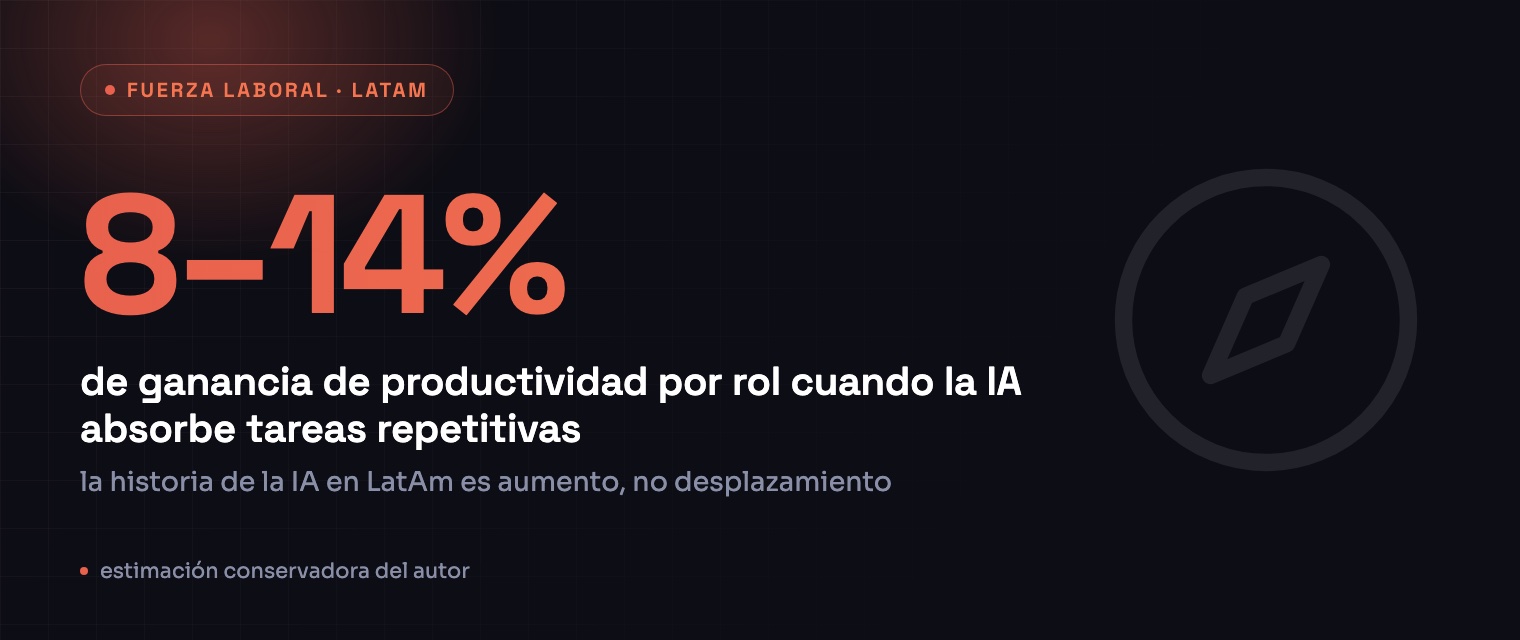
Hallazgo clave: En empleos con alta densidad de tareas repetitivas, mi estimación conservadora sitúa las ganancias de productividad específicas del puesto entre el 8 y el 14 % a medida que la IA absorbe las capas de tareas repetitivas, mientras que los estudios académicos sobre IA generativa reportan incrementos del 15 % o más en promedio. No es una distribución uniforme. Se concentra en roles donde el trabajo estructurado y basado en reglas constituye una parte sustancial de la producción diaria, y esos roles abundan en las industrias dominantes de la región.
El mecanismo es la absorción de tareas, no la eliminación de roles. Dentro de cualquier rol de trabajador del conocimiento existe un conjunto de tareas genuinamente de alto valor, síntesis, criterio, gestión de relaciones, toma de decisiones estratégicas, y un conjunto mayor de tareas que existen porque hay que hacerlas, no porque requieran inteligencia humana. Es en esta segunda categoría donde opera la IA.
En concreto: la generación de un informe que exigía tres horas de extracción de datos y formato ahora se resuelve en minutos. Los flujos de ingreso de datos que consumían el tiempo de los analistas en las organizaciones de servicios financieros los gestionan canalizaciones de IA. El contenido en primer borrador, resúmenes de mercado, comunicaciones internas, documentos para clientes, pasa de la página en blanco a un borrador utilizable en el tiempo que antes tomaba abrir la plantilla. Las tareas de agendamiento y coordinación que requerían cruzar manualmente calendarios y disponibilidad las gestionan agentes de IA que presentan opciones y confirman reservas.
No son ahorros de tiempo triviales. En un rol típico de operaciones de nivel intermedio en una empresa brasileña o mexicana, entre el 35 y el 45 % de las horas semanales se dedican a tareas de este tipo. Cuando la IA absorbe esa capa, el trabajador no desaparece de la organización: queda liberado para operar al nivel que la organización realmente necesita. La unidad de producción por trabajador aumenta de forma sustancial, sin sumar la plantilla que el mercado no puede ofrecer.
Este es el mecanismo del alza de productividad. No es magia. Es redistribución de tareas a escala, ejecutada de forma sistemática en roles que la escasez de talento regional ha dejado crónicamente con pocos recursos.
La selección inteligente de CV reduce a la mitad el tiempo de contratación, y disminuye el sesgo
Los departamentos de RR. HH. en América Latina operan bajo una presión sostenida. En mercados de talento competitivos, un proceso de contratación lento no es un inconveniente administrativo: es una desventaja competitiva. Un candidato calificado que espera tres semanas por una respuesta de preselección es un candidato que aceptó una oferta en otro lado hace dos semanas. La rapidez es una variable estratégica de la adquisición de talento, no un detalle operativo.
La selección de CV basada en machine learning ataca directamente esta restricción. En implementaciones en toda la región, los sistemas de selección con ML han reducido el tiempo hasta la primera entrevista hasta en un 50 %. El mecanismo: en lugar de que un reclutador lea y clasifique manualmente 200 postulaciones a lo largo de tres días, el modelo procesa las 200 en minutos, aplica criterios de puntuación estructurados frente a los requisitos del puesto y presenta una lista de finalistas ordenada para revisión humana. El tiempo del reclutador se destina al trabajo de alto valor, conversaciones, evaluación, valoración cultural, no al cribado por volumen.
El efecto de reducción del sesgo es igual de significativo y, de forma consistente, está subreportado en el contexto latinoamericano. La selección humana de CV activa un conjunto predecible de sesgos: el sesgo de afinidad hacia candidatos de las mismas instituciones educativas, el sesgo por el nombre que opera según líneas étnicas y de género, los efectos de contraste en los que la calidad de los candidatos evaluados antes distorsiona el juicio sobre los posteriores, y el sesgo de fatiga, donde la calidad del cribado se degrada a medida que aumenta el volumen. La puntuación estructurada con ML aplica los mismos criterios, en la misma secuencia, a cada candidato, sin la variabilidad que introduce cualquiera de estos factores.
Lo que el modelo realmente evalúa: la coincidencia de habilidades con los requisitos del puesto, la relevancia de los patrones de experiencia, la distribución de antigüedad, los indicadores de competencia presentes en las descripciones de puesto y las señales de progresión profesional vinculadas a resultados. Cuando estos modelos se entrenan con datos de desempeño laboral en lugar de datos históricos de contratación, pueden identificar candidatos con probabilidades de tener éxito en el puesto, no candidatos que se parecen a personas contratadas antes. Es una distinción relevante en mercados donde los patrones históricos de contratación han subrepresentado de forma sistemática a ciertos grupos demográficos.
Detección predictiva de rotación: intervenir antes de la renuncia
La rotación voluntaria en las organizaciones latinoamericanas es costosa a una escala que la mayoría de los equipos de liderazgo subestima de forma sistemática. Cuando se va un empleado de alto rendimiento, la organización absorbe costos directos (reclutamiento, onboarding, capacitación del reemplazo) y costos indirectos (pérdida de productividad durante la vacante y el periodo de adaptación, transferencia de conocimiento institucional, alteración del equipo). En mercados con escasez de talento, los costos indirectos suelen ser la cifra mayor.
El enfoque convencional de la retención es reactivo: el empleado renuncia, RR. HH. realiza una entrevista de salida y la organización descubre lo que pudo haber hecho distinto, demasiado tarde para actuar. La detección predictiva de rotación invierte esta secuencia. El modelo revela señales de alerta temprana antes de que el empleado haya tomado la decisión de renunciar, lo que da a los líderes una ventana para intervenir mientras la relación aún se puede rescatar.
Las señales de comportamiento que preceden a una salida voluntaria son consistentes y detectables. La caída en las puntuaciones de compromiso en las encuestas internas. La menor participación en reuniones voluntarias, proyectos entre equipos o comunidades internas. Una mayor latencia de respuesta en las comunicaciones internas, no causada por la carga de trabajo, sino por la desconexión psicológica. La volatilidad en las calificaciones de desempeño, ya sea en descenso o estancadas tras un periodo de crecimiento constante. Cambios en los patrones de ausencias y horas extra. El menor uso de las plataformas internas de aprendizaje y los recursos de desarrollo.
Ninguna de estas señales, por sí sola, predice la salida de forma fiable. El valor del modelo está en el reconocimiento de patrones: identificar la combinación y la trayectoria específicas de señales que, en conjunto, se correlacionan con el riesgo de salida en un horizonte de 60 a 90 días. Cuando el modelo detecta un riesgo elevado, un líder puede iniciar una conversación dirigida, sobre la trayectoria de desarrollo, la compensación, el alcance del rol o el entorno laboral, antes de que el empleado se haya comprometido mentalmente con irse. La investigación es consistente: la intervención temprana cambia de forma sustancial el resultado de retención.
La arquitectura que hace posible esto no es una sola fuente de datos. Se nutre de datos del sistema de RR. HH., datos de gestión del desempeño, datos de plataformas de compromiso y datos de patrones de comunicación, agregados a nivel de empleado y procesados contra un modelo entrenado con datos históricos de salidas de poblaciones comparables. El resultado es una puntuación de riesgo con indicadores de los factores que contribuyen, no un volcado de datos en bruto. El objetivo es ofrecer inteligencia accionable para los líderes, no construir un aparato de vigilancia.
La arquitectura del aumento de capacidades: rediseñar los roles en torno a la IA
Las ganancias de productividad del aumento de capacidades con IA no se materializan de forma automática. Las organizaciones que añaden herramientas de IA sobre descripciones de puesto sin cambios no obtienen incrementos de productividad del 14 %. Obtienen el 14 % de las tareas hechas dos veces, por un humano que no confió en el resultado de la IA y rehízo el trabajo a mano, o por una IA que generó un resultado que el humano no tuvo tiempo de revisar. El dividendo del aumento de capacidades requiere un rediseño intencional de los roles.
La pregunta del rediseño es específica: cuando la IA absorbe el 30 % del volumen de tareas de un rol, ¿en qué se convierte ese rol? No es una pregunta retórica. Exige una auditoría del rol a nivel de tareas, clasificando cada actividad según si la IA puede absorberla, si la IA puede asistirla o si depende genuinamente de un humano, seguida de una decisión deliberada sobre qué llena la capacidad recuperada.
La nueva unidad de trabajo cambia. En un rol tradicional de analista de operaciones, la unidad de trabajo es el entregable: el informe, el resumen de datos, la presentación. En un rol aumentado, la unidad de trabajo se desplaza hacia la decisión: la conclusión extraída del análisis generado por IA, la recomendación estratégica construida sobre el resumen producido por la IA, el juicio que ningún modelo puede emitir porque requiere contexto organizativo, conocimiento de las relaciones y una responsabilidad que solo carga un trabajador humano. El rol pasa a tratarse menos de producción y más de dirección, curaduría y criterio.
Esto exige una inversión paralela en el desarrollo de capacidades. Los trabajadores cuyos roles se rediseñan en torno a la IA necesitan desarrollar competencias en flujos de trabajo de colaboración con IA, evaluación de resultados y toma de decisiones de orden superior que la capacidad recuperada ahora les exige. Las organizaciones que rediseñan roles sin invertir en este desarrollo descubren que la capacidad recuperada no se traduce en producción estratégica, se traduce en tiempo subutilizado. La arquitectura del aumento de capacidades es rediseño de roles más desarrollo de capacidades, ejecutados juntos.
Las organizaciones que lo están haciendo bien en América Latina comparten un patrón común: tratan el aumento de capacidades con IA como una estrategia de fuerza laboral, no como un despliegue tecnológico. Involucran a RR. HH., al liderazgo de operaciones y a los líderes de primera línea en el proceso de rediseño. Establecen expectativas explícitas sobre lo que entregan los roles aumentados. Y miden la productividad a nivel de resultados, decisiones tomadas, clientes atendidos, problemas resueltos, no a nivel de tareas completadas. La métrica de tareas se desmorona cuando la IA absorbe tareas. La métrica de resultados es la que revela si el aumento de capacidades está funcionando.
El enfoque es la estrategia
Las organizaciones que estarán mejor posicionadas en los mercados de talento latinoamericanos durante los próximos cinco años no son las que desplegaron más herramientas de IA. Son las que adoptaron el enfoque correcto desde el inicio: aumento de capacidades, no reemplazo. Expansión de capacidad, no reducción de plantilla.
Ese enfoque determina cada decisión posterior. Qué aplicaciones de IA priorizar. Cómo comunicar el cambio a los empleados. Cómo rediseñar los roles. Cómo medir el éxito. Cómo asignar el dividendo de productividad que genera el aumento de capacidades con IA. Las organizaciones que operan desde el enfoque del desplazamiento toman decisiones distintas en cada paso, y la mayoría de esas decisiones optimizan para el resultado equivocado en un mercado definido por la escasez de talento.
La oportunidad de la IA en la fuerza laboral de América Latina no consiste en hacer más con menos personas. Consiste en hacer sustancialmente más con las personas que tienes, y competir con mayor eficacia por las personas que necesitas. La escasez de talento es real. El conjunto de herramientas del aumento de capacidades está disponible. La brecha entre ambas es una cuestión de estrategia.
El enfoque que adoptas al desplegar IA en un mercado con escasez de talento no es una decisión de comunicación. Es una decisión de estrategia. Y en América Latina, el aumento de capacidades es la estrategia que se ajusta a la realidad real del mercado.
Fuente: Semrush Research · Análisis de Fernando Angulo. Las opiniones son del autor y no representan a Semrush ni a Adobe.
Preguntas frecuentes
El efecto predominante de la IA en los mercados laborales latinoamericanos es el aumento de capacidades, no el reemplazo. En roles con alta densidad de tareas repetitivas, mi estimación conservadora sitúa las ganancias de productividad a nivel de puesto entre el 8 y el 14 %, a medida que la IA absorbe las capas de tareas repetitivas y libera a los trabajadores para un trabajo estratégico y relacional de mayor valor. La principal restricción del mercado laboral en América Latina es la escasez de talento, no su exceso: la IA está atendiendo la escasez, no creando desplazamiento a gran escala.
El desplazamiento de la fuerza laboral ocurre cuando los sistemas de IA desempeñan un rol por completo y eliminan la necesidad de un trabajador humano en ese puesto. El aumento de capacidades ocurre cuando la IA absorbe capas específicas de tareas dentro de un rol, normalmente tareas repetitivas, basadas en reglas o de procesamiento de datos, mientras el trabajador humano redirige el tiempo recuperado hacia responsabilidades estratégicas, relacionales y que exigen criterio. El aumento amplía lo que un solo trabajador puede lograr; el desplazamiento elimina al trabajador. En el caso de América Latina, la evidencia apunta con fuerza al aumento de capacidades como patrón dominante.
La IA puede agilizar el filtrado, pero también reproducir o amplificar sesgos. Evalúa la pertinencia para el puesto, la accesibilidad y los resultados de selección, con revisión humana responsable. La consistencia no demuestra equidad.
La IA puede agilizar el filtrado, pero también reproducir o amplificar sesgos. Evalúa la pertinencia para el puesto, la accesibilidad y los resultados de selección, con revisión humana responsable. La consistencia no demuestra equidad.
La detección predictiva de rotación usa modelos de machine learning entrenados con datos históricos de empleados para identificar patrones de comportamiento que se correlacionan con la renuncia voluntaria antes de que esta ocurra. Entre las señales que rastrea el modelo están la caída del compromiso en plataformas internas, la menor participación en reuniones, la volatilidad en las calificaciones de desempeño, una mayor latencia de respuesta en las comunicaciones internas y los cambios en los patrones de horas extra o ausencias. Cuando el modelo detecta un riesgo elevado de salida, RR. HH. o el líder directo pueden intervenir, mediante una conversación, una oportunidad de desarrollo, un ajuste de compensación o un rediseño del rol, antes de que el empleado llegue al punto de decidir su renuncia formal.
En roles con alta densidad de tareas repetitivas, mi estimación conservadora sitúa el alza de productividad a nivel de puesto entre el 8 y el 14 %, impulsada por la absorción de las capas de tareas repetitivas por parte de la IA, mientras que los estudios académicos sobre IA generativa reportan incrementos del 15 % o más en promedio. No es un aumento uniforme entre todos los trabajadores: se concentra en roles con proporciones significativas de trabajo estructurado y basado en reglas: ingreso de datos, generación de informes, agendamiento, creación de primeros borradores de contenido y correspondencia rutinaria. Los trabajadores de estos roles que adoptan flujos de trabajo asistidos por IA recuperan bloques considerables de tiempo que pueden redirigir hacia actividades de mayor valor.
El rediseño de roles para el aumento de capacidades con IA exige una auditoría a nivel de tareas: identificar qué tareas específicas dentro de cada rol son candidatas a ser absorbidas por la IA (normalmente tareas basadas en reglas, intensivas en datos o repetitivas de alto volumen) y luego rediseñar el rol en torno a las tareas que permanecen y a las nuevas tareas de colaboración con IA que las sustituyen. Cuando se automatiza el 30 % del volumen de tareas de un rol, la capacidad resultante debe reasignarse de forma explícita a responsabilidades de mayor valor definidas, no dejarse como tiempo libre sin estructura. Los roles rediseñados con estructuras de tareas aumentadas claras superan a aquellos donde la IA simplemente se añade encima de las descripciones de puesto existentes.
América Latina enfrenta una escasez estructural de talento en las funciones de tecnología, ingeniería, finanzas y gestión, la demanda de trabajadores calificados supera ampliamente la oferta en la mayoría de los mercados principales. Esta escasez es la principal restricción del mercado laboral que enfrentan las organizaciones de la región, lo que significa que la IA opera como una herramienta de expansión de capacidad y no como un mecanismo de desplazamiento. La IA permite que menos trabajadores calificados logren más, amplía el alcance efectivo del talento sénior mediante roles júnior asistidos por IA y acelera el onboarding para que las nuevas contrataciones lleguen antes a una contribución productiva. La historia del aumento de capacidades es, en el fondo, una historia de escasez de talento.
 FA
FA
¿Estás construyendo tu estrategia de fuerza laboral con IA?
Ayudo a organizaciones en América Latina y en todo el mundo a navegar el aumento de capacidades con IA, los RR. HH. inteligentes y el futuro del trabajo.
Fuentes de la revisión
Guía oficial de Google para búsqueda con IA · Informe de rendimiento de IA generativa · Semrush AI Visibility Index, junio de 2026