 FA
FA
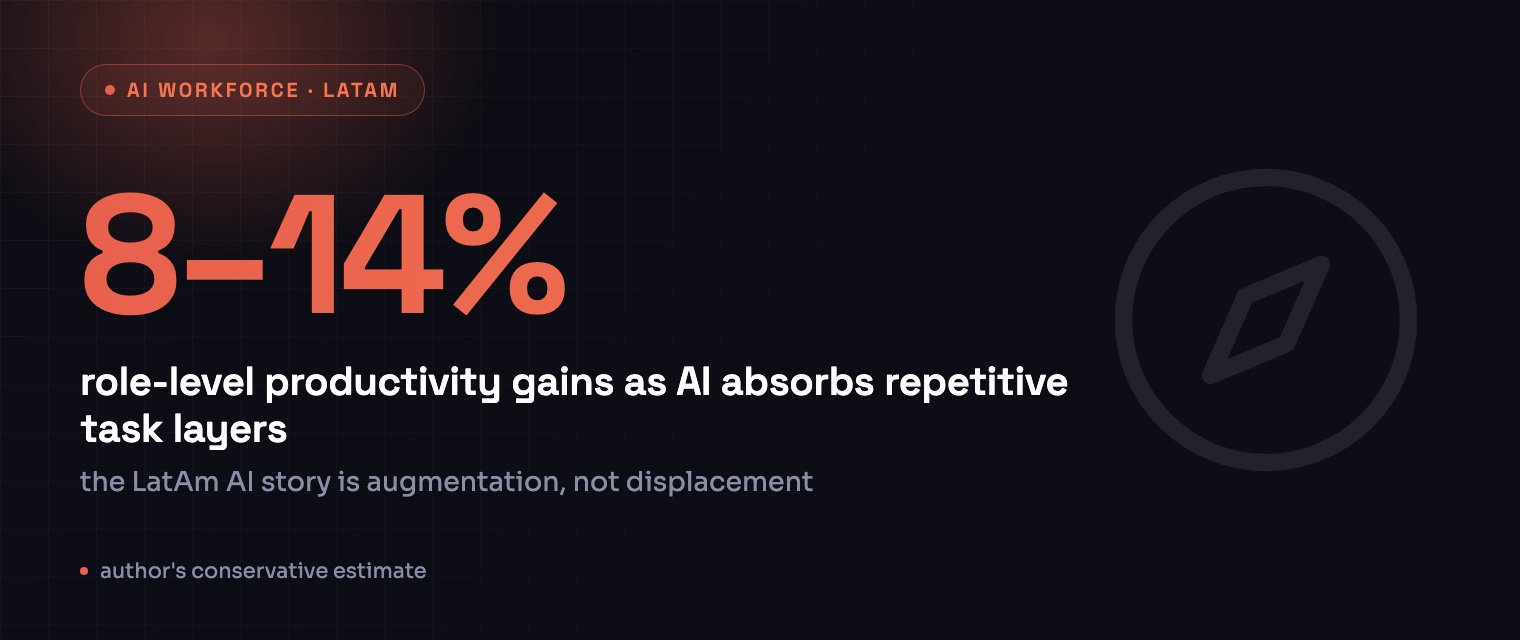
Quick answer:Job exposure to AI is not a measured productivity gain. A World Bank and ILO study estimated potential augmentation for 8–14% of jobs in Latin America and the Caribbean. The management task is to test which activities improve, under what conditions, and with what consequences for workers.
Start with the role and the local constraint
A regional exposure estimate cannot establish that every employer faces the same talent shortage or that AI will expand capacity rather than reduce headcount. Diagnose the role, hiring constraints, service demand and existing workload before choosing an intervention.
Separate three questions: which tasks a system can assist, whether the organization can deploy it responsibly, and whether the resulting work is useful. Technical capability does not answer the other two.
Augmentation potential is not a productivity percentage
The July 2024 World Bank and ILO analysis estimated that 8–14% of jobs could benefit from augmentation and that 2–5% faced potential full automation. These are modeled shares of employment, not realized gains in output or observed layoffs. Read the original regional study.
Keep this dated evidence as a historical reference. Do not label it a 2026 productivity result or turn the share of exposed jobs into a time-saving target for a particular employee.
Evaluate hiring assistance without promising speed or fairness
A screening tool can support a defined hiring workflow, but a consistent scoring process is not proof of fair selection. Assess the criteria, data quality, error rates and relevant subgroup outcomes. Keep human review and a route to challenge incorrect information.
This article does not establish that automated screening halves hiring time. If that is your objective, measure comparable time-to-stage and selection quality before and after a bounded trial. Record candidate mix, process changes and the cases requiring correction.
Treat retention scores as uncertain signals
A model trained on past departures does not know that a current employee intends to resign. A risk score needs validation in the population where it will be used. This article provides no validated 60–90-day prediction window or measured retention lift.
Start with a legitimate management question and the minimum necessary data. Evaluate false positives, missing context and the effect of any intervention. Do not infer disengagement from communication patterns alone or treat an estimated risk as a fact about a person.
Use 2026 research without mixing populations
Anthropic’s June 2026 Economic Index separates Claude product surfaces and analyses with different samples. Its linked survey includes about 9,700 respondents and explicitly is not representative of the general population. Read the report and its methodological notes.
That is newer evidence about a platform’s users, not a replacement estimate for Latin American employment or proof of a regional productivity gain. The useful lesson for a local evaluation is to preserve the task, product, population and observation period.
My proposed workflow is to choose one task, record the baseline, specify an acceptable output, run a limited trial with review, and compare quality, total time including rework, and downstream errors. Set the decision rule before examining the result. This is a management protocol, not a validated universal scale.
Decide from the measured outcome
An improvement in drafting time does not establish a better hiring decision, higher client satisfaction or a productivity gain across the company. Record the outcome the role exists to deliver and the person accountable for reviewing it.
If quality deteriorates or review consumes the apparent saving, revise or stop the trial. If the result is useful, document its conditions before extending it to another role or market.
Frequently asked questions
No. It is an estimated share of jobs with augmentation potential in a dated regional study, not a measured percentage increase in productivity.
No. Consistent automated scoring does not prove fairness. Selection criteria, errors, subgroup outcomes and human review need evaluation.
No. It describes selected Claude usage and survey samples. Its findings cannot be substituted for a representative regional labor-market estimate.
Define the task and baseline, then compare output quality, total time including review and rework, downstream errors and the decision affected.
Sources and scope
Bring the research to your event
Explore the keynotes for marketing leaders and the decision your audience needs to make.