 FA
FA
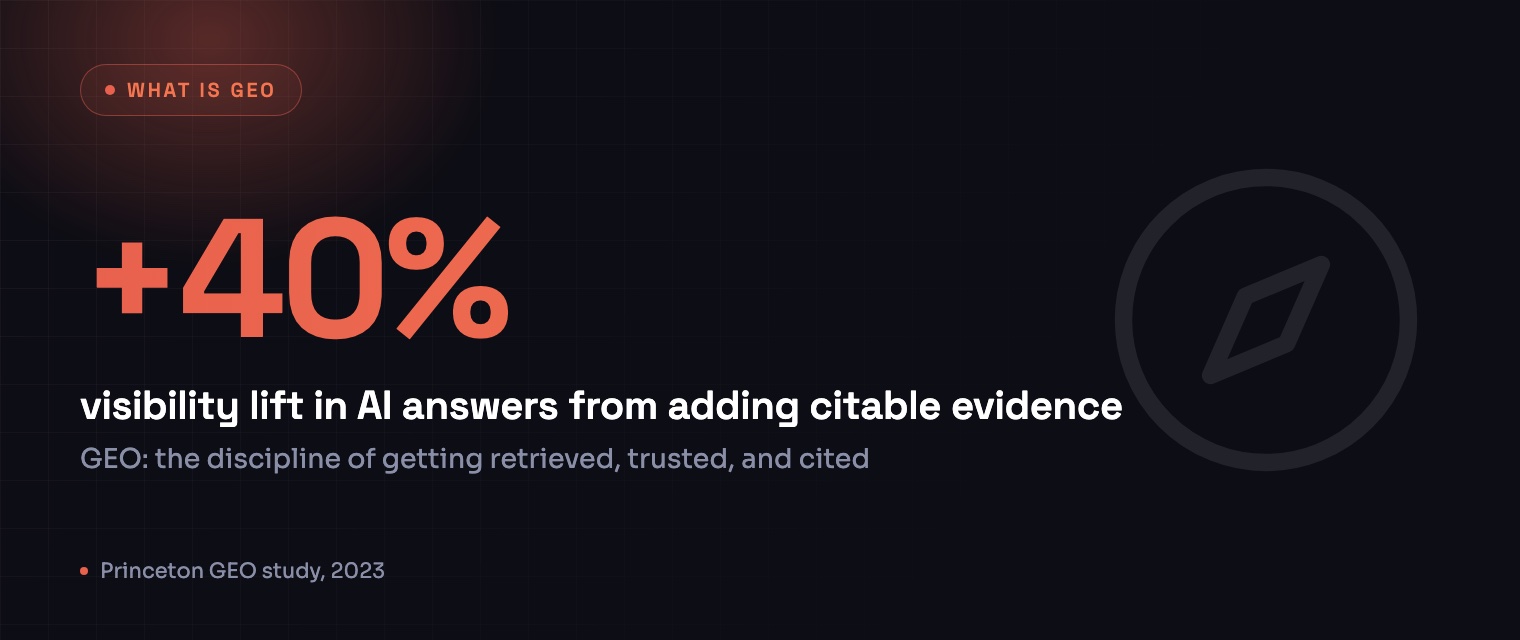
Quick Answer:Generative engine optimization (GEO) is the discipline of structuring and distributing content so AI-powered search engines, ChatGPT, Google Gemini, Google AI Mode, Google AI Overviews, retrieve it, trust it, and cite it inside the answers they generate. Where SEO optimizes for position in a list of links, GEO optimizes for presence inside a composed answer. The term was defined in a November 2023 Princeton and Georgia Tech research paper, whose controlled experiments showed the right content changes lift a source's visibility in AI answers by up to 40%.
The definition, one clause at a time
GEO is the discipline of structuring and distributing content so generative engines retrieve it, trust it, and cite it. Each verb is a separate battle. Retrieve: the engine's search layer has to find and parse your content at all, a step most sites fail silently, as I documented in The GEO Gap. Trust: the model has to resolve who you are and judge your claims credible against everything else it retrieved. Cite: your passage has to survive extraction, being quoted inside an answer, stripped of surrounding context, in competition for a handful of citation slots that range from about 3 per answer on Gemini to 15 on ChatGPT (Semrush AI Visibility Index 2026).
Notice what the definition does not say: nothing about rankings, nothing about keywords, nothing about any single platform. That's deliberate, and the rest of this piece is the evidence for why.
Where GEO comes from: a 2023 experiment, not a 2026 pitch
The term was coined in the November 2023 research paper “GEO: Generative Engine Optimization” by Pranjal Aggarwal and colleagues at Princeton and Georgia Tech, later presented at the ACM KDD '24 conference. The researchers built a benchmark of roughly 10,000 queries, simulated a generative engine's retrieve-then-compose pipeline, and tested nine content-modification methods against a control to see which made a source more visible in the generated answer.
The results gave the discipline its spine. The winning methods, adding statistics, adding quotations, and citing sources lifted a source's visibility by up to 40 percent on the study's position-adjusted metrics. The revealing loser: keyword stuffing produced no gain. In one controlled experiment, the field learned that the levers that built the SEO industry don't move AI citations, and that verifiable evidence does. Everything serious written about GEO since, including on this site, is a footnote to that finding.
GEO vs SEO: the actual difference
Semrush’s June 2026 release reports approximately 15 cited sources per ChatGPT answer versus 3 for Gemini in its US study. These are averages, not source limits. Mention–citation overlap is a separate measure and does not describe organic ranking overlap.
Two of my earlier pieces slice this boundary in more depth: GEO vs SEO: The Exact Line for the practitioner's split, and GEO vs AEO vs ASO for how GEO relates to its sibling acronyms. Short version there: AEO optimizes to be the answer , GEO (2023) to be cited in a generated answer, ASO (2025–26) to be acted on by agents .
For conference programmers, the GEO keynote for marketing leaders turns that distinction into a briefing on what the audience should measure, rebuild, and explain internally. You can also compare the AI search keynotes to choose the closest fit for your programme.
What GEO work actually consists of (four layers)
Strip away the vendor packaging and serious GEO programs work four layers, in order, the same stack the AI Visibility Index frames as Discoverability → Clarity → Authority → Trust:
| Layer | Question it answers | Typical work |
|---|---|---|
| 1. Discoverability | Can AI systems access and parse you at all? | Crawlability for AI agents, clean structure, schema markup for AI search, llms.txt |
| 2. Clarity | Can a model resolve who you are and what you claim? | Entity consistency everywhere; unambiguous, self-contained passages |
| 3. Authority | Do you publish evidence worth quoting? | Statistics, quotations, cited sources, the levers worth up to 40% in controlled tests |
| 4. Trust | Do the sources each platform relies on vouch for you? | Presence in platform source diets: Reddit (ChatGPT), Wikipedia (Gemini), YouTube (Google AI) |
Each layer is a precondition for the next, and the most common failure pattern I see is investing in layer 3 while layer 1 is broken, publishing quotable research that AI retrieval structurally cannot read. Once the layers are working, the program is managed with two KPIs, mention share and citation share per platform, on the monthly panel method I detail in How to Measure a GEO Campaign.
Why now: the click stopped being the unit of visibility
GEO's urgency is demand-side, not vendor-side. Roughly 68 percent of US Google searches now end without a click (SparkToro, 2026). When Google shows an AI summary, Pew Research Center's tracked-browsing study found clicks on traditional results drop to 8 percent of searches (from 15 percent), and 58 percent of people met at least one AI summary in a single month of ordinary searching. The interaction increasingly ends inside the answer, so brands compete for presence inside the answer. That is the entire strategic case, and it's measured, not predicted.
Three misconceptions worth killing early
"GEO is keyword optimization for chatbots." The founding experiment tested exactly this and it failed: keyword stuffing moved nothing while citable evidence moved up to 40 percent. GEO rewards proof density, not term frequency.
"Optimize for ChatGPT and you've optimized for AI." The platforms behave like different countries, citation density varies nearly fivefold, source diets diverge (Reddit vs Wikipedia vs YouTube), and mention–citation overlap spreads 34 points. Entity-level authority transfers; platform tricks don't.
Semrush’s June 2026 release reports approximately 15 cited sources per ChatGPT answer versus 3 for Gemini in its US study. These are averages, not source limits. Mention–citation overlap is a separate measure and does not describe organic ranking overlap.
Frequently Asked Questions
GEO is the discipline of structuring and distributing content so AI search engines, ChatGPT, Gemini, AI Mode, AI Overviews, retrieve it, trust it, and cite it inside generated answers. SEO optimizes for position in a list; GEO optimizes for presence inside a composed answer. The term was defined in a 2023 Princeton/Georgia Tech paper whose experiments showed up to 40% visibility gains from the right content changes.
Pranjal Aggarwal and colleagues at Princeton University and Georgia Tech, in the November 2023 paper “GEO: Generative Engine Optimization,” presented at ACM KDD 2024. They built a ~10,000-query benchmark and measured which of nine optimization methods increased citation visibility in generated answers.
No, shared foundation, different finish line. Both need crawlable, quality, authoritative content. SEO earns a ranked position; GEO earns a citation inside an answer. The levers diverge: statistics, quotations, and sources lifted AI visibility up to 40% in controlled tests, while keyword optimization produced no gain.
In Semrush’s June 2026 companion survey, 81% of organizations integrating SEO and AI visibility reported increased AI traffic or leads, compared with 36% managing them separately. This self-reported association does not establish causation.
Four layers in order: verify AI can access and parse your site (discoverability); make entity and claims unambiguous (clarity); add citable evidence to key pages (authority); build presence in each platform's trusted sources, Reddit, Wikipedia, YouTube (trust). Then measure monthly: mention share and citation share, per platform.
Need GEO explained to a room that's tired of acronyms?
I speak at 50+ events a year on AI search and GEO, researcher-first, built on the 126M-prompt AI Visibility Index dataset.
Sources checked in this revision
Google’s official AI-search guidance · Generative AI performance reporting · Semrush AI Visibility Index, June 2026