 FA
FA
Quick answer:AI visibility describes whether, where and how a brand or its content appears in AI-generated answers. Mention rate, citation rate, recommendations, prominence and accuracy answer different questions. Measure them under declared conditions; no single score is a universal definition.
Before you start: define the outcome
A marketing dashboard can look precise while combining different outcomes. I want the report to tell a team what happened, to which audience question, and what decision follows. Start by defining the observation rather than accepting the label on a score.
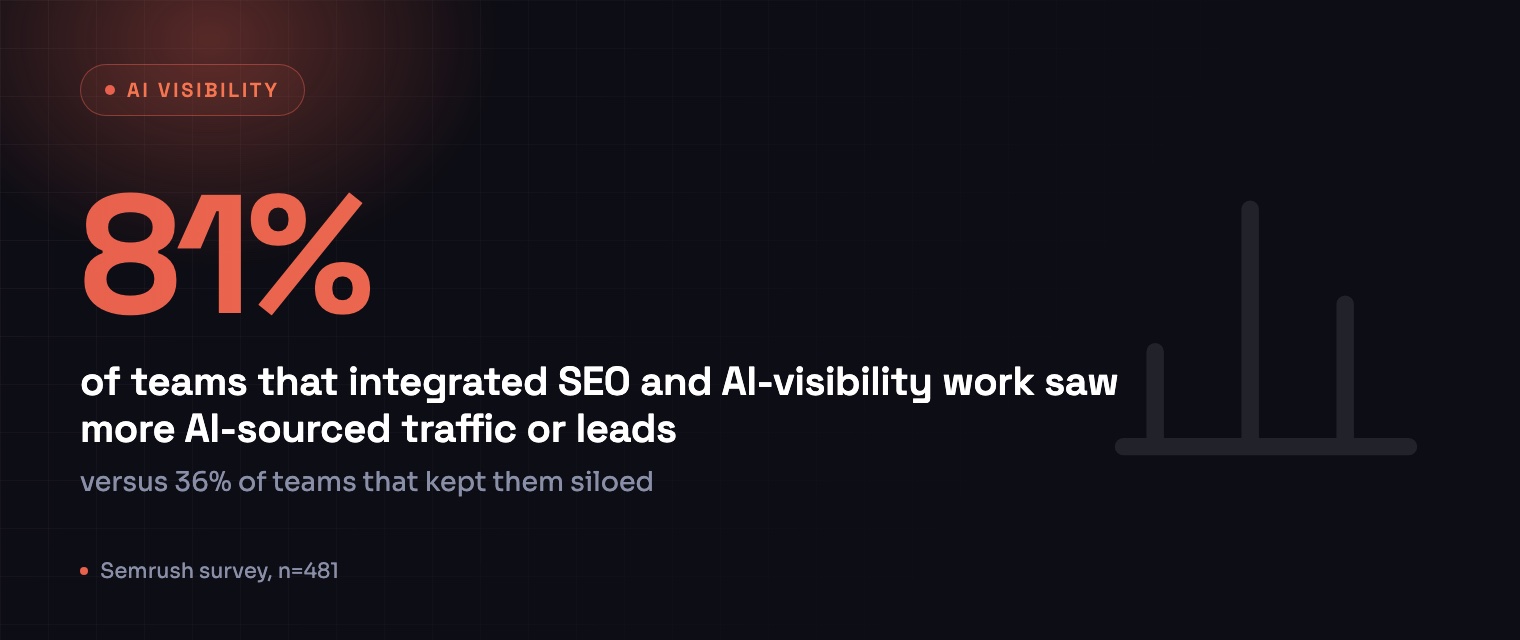
Semrush’s June 2026 release reports that 45% of surveyed marketing leaders could not accurately measure brand visibility in generated answers. This concerns accuracy, not an inability to detect any appearance. Its companion survey associates integrated SEO and AI workflows with more reported traffic or leads; that association does not prove that integration caused the improvement.
SEO visibility usually describes presence in organic results under a specified methodology. AI visibility concerns generated answers and their sources. These surfaces can overlap. A good organic position does not establish a citation, and an AI citation does not establish a visit or conversion.
Step 1. Write your measurement rules
Do this: Choose the measures your decision needs. Write the counting rule and denominator for each before collecting answers.
| Measure | Operational definition | Limit |
|---|---|---|
| Mention rate | Valid answers naming the brand / valid answers | Does not show a source or endorsement |
| Owned-domain citation rate | Valid answers linking an owned domain / valid answers | Count each answer once, even with several links |
| Exact-URL citation rate | Valid answers linking the target page / valid answers | Different from total citation occurrences |
| Recommendation rate | Valid answers explicitly recommending the brand / valid answers | Record the use case and conditions |
| Prominence | A declared placement rule, such as first named option | Not comparable if answer formats differ |
| Accuracy | Correct checked claims / checkable brand claims | Keep unsupported or unverifiable claims separate |
These measures overlap. Never add their percentages into a total. Define the brand aliases, owned domains and recommendation criteria before coding. Keep the full answer so a second reviewer can check a disputed classification.
Hypothetical example: 24 attempted runs produce 20 valid answers and four failures. Eight answers mention the brand, three cite its domain and two recommend it. Mention rate is 40%, citation rate 15% and recommendation rate 10%. The failures remain visible as four of 24 attempts; they are not brand absences.
Competitive share uses a different denominator. If your brand has eight recorded mentions and the declared comparison set, including your brand, has 32 mentions in total, its share of those mention occurrences is 25%. That is neither a 25% answer rate nor 25% ownership of the topic. For source-level interpretation, use the citation-authority audit.
Before moving on: Two reviewers can apply the same rules, including aliases, recommendation criteria and comparison-set membership.
Step 2. Fix the observation conditions
Do this: Create a row for each platform and mode. Declare market, language, search setting and panel version; retain these fields with every run.
The Semrush AI Visibility Index analyzed 126 million US prompts from January to April 2026 across 22 industries and four platforms. The release reports different citation patterns between platforms. That is a reason to segment your report, not a universal instruction to publish on a particular third-party site. Study scope and findings, data © Semrush.
Keep ChatGPT, Gemini, AI Mode and AI Overviews separate. Declare mode, search availability, market, language and collection date. A search-enabled answer is not comparable to one generated without search merely because the product name matches. A small selected panel describes that panel; it is not population-wide market share.
Strong visibility means accurate, relevant appearances for your chosen audience decisions. Define success against a baseline and business need. Another vendor’s scale or a famous consumer brand’s score is not an appropriate target for an expert’s website.
- 01Answer observation
Mention, citation, recommendation and accuracy in the panel.
- 02Website behaviour
Identifiable referral visits and their on-site actions.
- 03Business outcome
Qualified enquiries and confirmed opportunities.
Before moving on: You know which observations can be compared and which must remain separate.
Step 3. Run the panel and produce the baseline
Do this: Follow the collection sequence below, then complete the report template. Preserve raw answers and failure states before calculating the summary.
- Choose the questions. Include the decisions your audience actually faces. Label whether each is observed, derived or proposed. Separate branded diagnosis from unbranded discovery.
- Freeze a comparison version. Keep exact wording and IDs. Put exploratory additions in a separate panel until the next planned version.
- Capture the answers. Record platform, mode, search setting, language, market, date, repetition, output and source URLs. Retain failures and sample sizes.
- Code consistently. Apply the definitions above. Check disputed labels and preserve the raw evidence.
- Prepare the baseline. Calculate each rate with its declared denominator and preserve the records used. Take unresolved patterns to the investigation in Step 4.
Google’s Generative AI performance report, whose worldwide rollout completed on 31 August 2026, adds AI Overviews and AI Mode impressions with page, country, date and device dimensions. Availability depends on sufficient impressions. It does not provide full query, click or revenue attribution and does not measure other providers.
For AI Overviews, record a successful search that does not trigger an overview separately from a request failure or an answer without the brand. Conditional answer rates exclude searches with no overview. If useful, report overview availability as searches producing an overview divided by eligible successful searches.
A spreadsheet can support a small manual panel. Automation helps with scale, but cannot repair unclear definitions. Use the campaign measurement guide for operational follow-through. The next deliverable is a baseline with a known denominator and a decision log.
Before moving on: A reviewer can reproduce the rates from the records and identify the owner of the next investigation.
Step 4. Interpret patterns and choose the next check
Do this: Inspect the baseline patterns using the table. Keep multiple explanations until further checks distinguish them.
| Observed pattern | Possible explanations | Next check |
|---|---|---|
| Mentions without owned citations | Independent sources answer the question; owned evidence is missing; intent differs | Inspect cited pages and the exact question |
| No mention and no citation | Panel relevance, access, competition or response variation | Check relevance and access, then repeat |
| Citation with inaccurate description | Ambiguous source, outdated facts or a generated error | Compare the cited passage with verified facts |
| Results concentrated on one platform | Different modes, sources, questions or selection | Match conditions before comparing |
Access, identity clarity, evidence quality and corroboration are useful audit lenses. They are not mandatory stages that every engine follows in order. After collecting the baseline, fix a verified defect because it is wrong or unhelpful, then test whether the observed answer changes. Keep alternate explanations in the record.
Before moving on: The log separates observations, possible explanations and the next check with its owner.
Check your finished work
Copy-and-complete template
This is a working template, not observed results.
Panel version / question IDs: [ ]
Platform / mode / search / market / language / date: [ ]
Attempted runs / valid answers / failures / no overview: [ ]
Metric / numerator / denominator / result: [ ]
Comparison set, including own brand if applicable: [ ]
Observed pattern / possible explanations: [ ]
Next check / owner / review point: [ ]- Questions have stable IDs and observed, derived or proposed provenance.
- Raw answers, URLs and run conditions are retained.
- Failures, non-triggered overviews and valid brand absences stay distinct.
- The comparison-set denominator explicitly includes the relevant brands.
- The baseline ends with a checkable next decision, not a causal claim.
Frequently asked questions
AI visibility describes whether, where and how a brand or its content appears in AI-generated answers. Mention rate, citation rate, recommendations, prominence and accuracy answer different questions. Measure them under declared conditions; no single score is a universal definition.
SEO visibility describes presence in organic results under a defined method. AI visibility describes appearances in generated answers and their sources. The surfaces can overlap, but a ranking does not establish a citation or recommendation.
Choose a fixed question panel, define counting rules and record the collection conditions in a spreadsheet. Save complete answers and sources, separate failures and non-triggered overviews, then calculate rates with declared denominators. Use the baseline to choose the next investigation.
There is no universal target across tools and panels. Compare a declared method against its own baseline and relevant audience decisions. Examine accuracy and business outcomes separately.
Several explanations are possible, including the prompt’s intent, use of independent sources, missing owned evidence or access issues. Inspect the answer and cited pages before choosing a fix.
Make AI visibility useful to a leadership audience
I explain how to separate answer visibility, evidence quality and business outcomes in conference keynotes and executive briefings.