 FA
FA
Quick Answer:Open-source AI can give organizations more deployment and data-control options, but it does not guarantee lower total cost, better regional performance, or closure of Latin America’s AI investment gap. Compare quality, security, latency, skills, and end-to-end cost on the same workload.
The Investment Gap Does Not Explain Its Own Causes
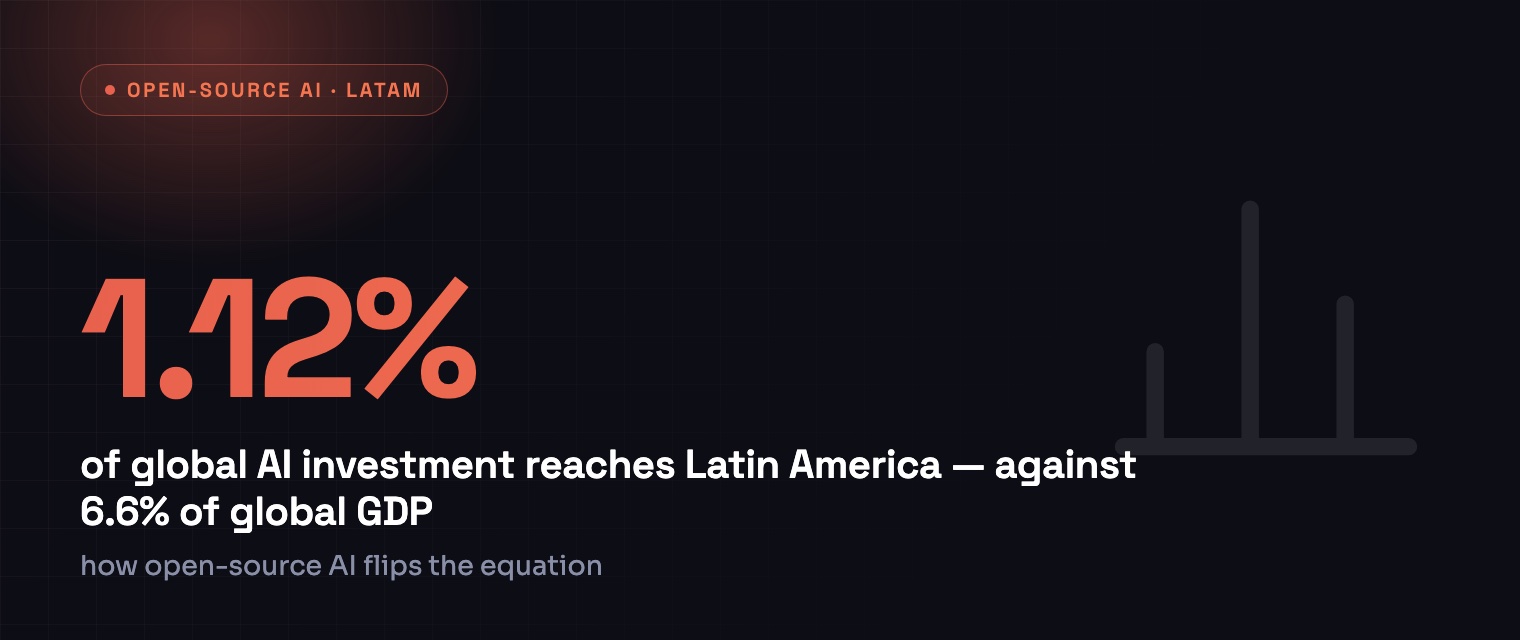
ECLAC and the 2025 Latin American Artificial Intelligence Index report that the 19 countries covered represent 6.6% of global GDP but receive 1.12% of global AI investment. The comparison establishes an investment imbalance. It does not, by itself, identify a single cause or show that open source will close it.
Three mechanisms are worth testing rather than assuming: dollar-denominated software prices relative to local budgets, infrastructure availability and latency, and model quality on regional language and tasks. Their weight will differ by country, industry, and workload.
For an SME, the decision is not “open versus proprietary” in the abstract. Compare the same task across the available options. Include subscription or usage fees, integration, hosting, staff time, security review, failure handling, and support.
Language fit also needs direct evaluation. Build a test set from real customer questions, documents, and terminology in the target market. Report results by locale and task. A model trained globally can perform well, and a regional model can still fail. The label does not answer the performance question.
Open Source Changes the Cost Model, Not Always the Total Cost
Open-weight models can remove per-token vendor fees and allow self-hosting, but they add infrastructure, engineering, monitoring, security, and support costs. There is no defensible universal 5-to-7x saving. The result changes with model size, utilization, latency target, workload, cloud region, and team capability.
Benchmark the same representative workload on shortlisted APIs and open-weight deployments. Measure answer quality, failure rate, latency, throughput, staff time, hosting, observability, security review, and maintenance. A smaller open model may win one task and lose another.
Document processing, catalog support, and demand analysis are plausible candidates for testing. Whether an open-weight deployment is affordable depends on volume, accuracy requirements, available skills, hosting, and the cost of human review. Treat each as a workload comparison, not as a promised saving.
Self-hosting can provide more control over where data is processed, but only when the surrounding logs, vendors, backups, access controls, and operational procedures are configured accordingly. Open weights do not automatically create privacy or security.
Open-weight models can also support fine-tuning and on-premises deployment. Whether fine-tuning improves quality enough to justify its data and maintenance cost must be tested against simpler retrieval, prompting, or managed-model alternatives.
For a Latin American SME weighing the two paths, the contrast is structural, not incremental:
| Dimension | Open-Source AI | Proprietary AI |
|---|---|---|
| Cost model | Infrastructure plus engineering, operations, and support | Usage, subscription, or contract pricing plus integration |
| Implementation cost | Workload-dependent; benchmark total cost | Workload-dependent; benchmark total cost |
| Data control | More deployment control when self-hosted correctly | Depends on vendor terms, region, and configuration |
| Fine-tuning | Available, with data and operations requirements | Available from some vendors and model providers |
| Regional fit | Must be tested by locale, task, and chosen model | Must be tested by locale, task, and chosen model |
Regional Language Performance Must Be Tested
Model quality can vary by language variety, domain, and task. That is a reason to build evaluation sets from real regional inputs, not to assume every global model fails or every regional model performs better.
Operational language differs across Mexico, Colombia, Peru, Argentina, Brazil, and the region’s many communities. The relevant question is whether a model handles the vocabulary, factual context, safety requirements, and task instructions of the target market. Native reviewers and real inputs provide a stronger answer than assumptions about where a model was built.
The language question extends beyond Spanish and Portuguese. The World Bank estimates 42 million Indigenous people in Latin America, and regional language coverage varies widely. For a government, banking, or essential service, test access and task completion with the communities affected instead of treating standard Spanish as a sufficient proxy.
Culture should not be reduced to regional stereotypes. Evaluate the behaviors that matter for the service: terminology, politeness, escalation, local regulation, factual accuracy, and successful task completion. Segment results by market rather than assigning one commercial culture to Latin America.
Evaluate terminology, factual accuracy, safety, tone, and task completion with reviewers from the intended market. Report results by locale and use case. Broad cultural claims are not a substitute for that measurement.
Latam-GPT Represents a Regional AI Architecture, Not Just a Model
LatamGPT-SFT 1.0 is available as open weights under the Llama 3.1 Community License. Its model card lists Spanish, Portuguese and English, and approximately 297 billion tokens in Corpus 1.0. Evaluate this named version on your task; this does not establish performance in other languages or superiority over alternatives.
The project’s central technical question is whether its regional corpus improves performance on regional tasks. Corpus size alone cannot answer that. The needed evidence is model documentation, data governance, independent benchmarks by locale and task, safety evaluation, and clear licensing.
Regional data construction is important, but corpus size and origin do not prove downstream quality. Independent benchmarks, model documentation, licensing terms, safety evaluation, and task-level comparisons are still needed before claiming superiority.
The initiative's collaborative structure, bringing together universities, research institutions, and technology organizations across multiple countries, is itself significant. It reflects an understanding that digital sovereignty in AI cannot be achieved by any single country in the region acting alone. Brazil, Mexico, Colombia, Argentina, and Peru each have distinct linguistic and commercial profiles. A pan-regional model requires pan-regional data partnerships, and the institutional trust to share proprietary corpora for a shared public good.
LatamGPT-SFT 1.0 is available as open weights under the Llama 3.1 Community License. Its model card lists Spanish, Portuguese and English, and approximately 297 billion tokens in Corpus 1.0. Evaluate this named version on your task; this does not establish performance in other languages or superiority over alternatives.
Three Applications Where Latin American SMEs Can Deploy Open-Source AI Today
SMEs do not need to wait for a regional foundation model to test bounded use cases. Customer support, document processing, and forecasting are candidates for evaluation, not guaranteed high-ROI deployments.
Customer service. Test a bounded set of low-risk intents with human escalation. Compare resolution rate, factual accuracy, customer satisfaction, latency, and cost across open and managed options before expanding.
Document operations. Evaluate extraction and classification on a labeled sample of real invoices, contracts, or filings. Preserve human review for material decisions and calculate total cost from measured error rates and handling time.
Demand and supply-chain analysis. Compare a model against a simple statistical baseline on historical data. Use backtesting and business constraints before allowing recommendations to affect inventory or purchasing.
The common thread is evaluation. Choose the smallest model and deployment approach that meets a defined quality, risk, latency, and cost threshold. The winning option may be open, proprietary, or hybrid.
What Open Source Can and Cannot Solve
Open source can improve deployment choice, inspection, customization, and local capacity. It cannot by itself supply investment, reliable infrastructure, representative data, skilled teams, governance, or sustainable institutions.
The useful distinction is between deploying models built elsewhere and investing in regional data, research, and talent. Each path has different costs and dependencies. Neither automatically closes the investment, language, or capability gaps.
Digital sovereignty is a policy and economic question about control, dependency, interoperability, and institutional capacity. Regional infrastructure can reduce some dependencies, but it also creates costs and responsibilities. The tradeoff should be evaluated rather than treated as an automatic outcome of an open license.
SMEs can act without waiting for the regional investment gap to close. A bounded pilot can test whether an open, proprietary, or hybrid system builds useful internal competency and meets a defined business threshold. Any durable advantage must be demonstrated in operations, not assumed from the license.
The opening exists now. The 1.12% statistic is a constraint on capital, not on intelligence, initiative, or the willingness to build.
Frequently Asked Questions
Open-source and open-weight AI cover different licenses and degrees of access to weights, code, and training information. Some models can be self-hosted or fine-tuned, but licensing, total cost, security, and operational requirements vary.
CEPAL reported that the 19 countries covered by the 2025 ILIA represented 6.6% of global GDP but received 1.12% of global AI investment. The comparison documents an investment gap; it does not by itself establish its causes or quantify business-level effects.
There is no universal cost-reduction multiple. Compare end-to-end quality and cost for the same workload, including hosting, engineering, security, monitoring, support, and proprietary API prices.
Do not assume that a global model fails or a regional model performs better. Evaluate real inputs from the intended locale and task, including terminology, factual accuracy, safety, tone, task completion, latency, and cost, with reviewers from the market.
LatamGPT-SFT 1.0 is available as open weights under the Llama 3.1 Community License. Its model card lists Spanish, Portuguese and English, and approximately 297 billion tokens in Corpus 1.0. Evaluate this named version on your task; this does not establish performance in other languages or superiority over alternatives.
Digital sovereignty is a policy and economic question about control, dependence, interoperability, data, and institutional capacity. Regional infrastructure can reduce some dependencies while adding cost and operational responsibility. An open license does not settle the balance.
Customer support, document processing, and demand forecasting are candidates for bounded tests. ROI is not guaranteed. Define a baseline and compare quality, failure rate, latency, staff time, risk, and end-to-end cost before expanding.
SMEs should compare open, proprietary, and hybrid systems on one bounded workload. Measure quality, failure rate, latency, staff time, risk, and total cost. The effect on productivity or competitiveness must be demonstrated in operations rather than inferred from the license.
Taking AI to Latin American markets?
Fernando Angulo advises global enterprises and regional organizations on AI adoption strategy, digital market intelligence, and the future of search.
Sources checked in this revision
Google’s official AI-search guidance · Generative AI performance reporting · Semrush AI Visibility Index, June 2026