 FA
FA
A rise in AI citations leaves a practical reporting question unanswered: did the answer name your company, recommend it, or only link to one of your pages?
Before using that increase to justify more content work, inspect the answers. Record what appeared, what it means, and who should act on it.
In Semrush’s study with Kevin Indig and Growth Memo, a ghost citation is a source link without the brand being named in the answer text. That distinction can help a team avoid treating every citation as the same kind of progress.
Medium was cited without being named
Semrush’s study with Kevin Indig and Growth Memo reports that medium.com was cited 16 times, while Medium was never named in the answers. This is a concrete example of the distinction: a domain can appear as a source without its brand appearing in the answer prose.
Source: Semrush’s ghost-citations study, section 3.
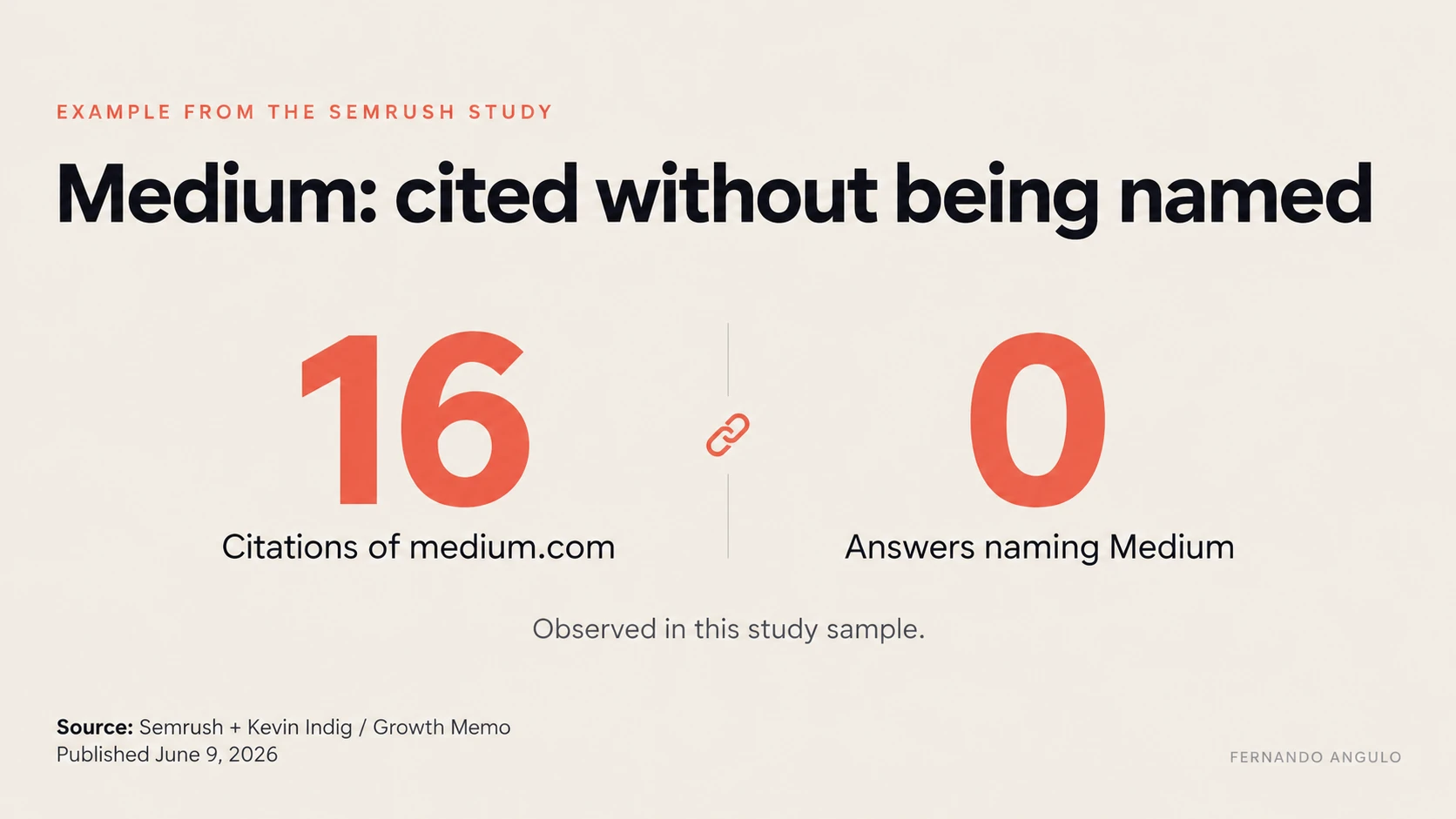
Study-reported domain/platform counts. They do not establish whether individual Medium authors were named or what readers noticed.
That makes Medium a useful example for reporting: its source links and brand mentions tell different stories.
Choose what to investigate
If you are preparing a marketing review, start with the question the report needs to answer. Are buyers encountering your company as a source, a named option, or a recommendation? Then classify the answers behind the count.
| Observation | Next investigation | Useful output |
|---|---|---|
| Own page cited, brand unnamed | Is attribution clear and relevant on the source page? | One justified editorial hypothesis, or a decision to leave the page unchanged |
| Brand named, own site not cited | Which sources shape the description, and are the facts accurate? | A source and accuracy record, with any correction needed |
| Brand named without a recommendation | Is the mention relevant, neutral, critical, or incidental? | An assessment of the buyer’s intent and the answer’s context |
| Neither own citation nor brand mention | Which competing sources and options answer the question? | An evidence gap to investigate |
These patterns can overlap: a brand can be named without either an owned citation or a recommendation. Record each observation separately, then choose the investigation that addresses the decision at hand. These are proposed diagnostic actions, not guaranteed ways to change an AI answer.
Consider a hypothetical supplier-selection answer. It advises readers to compare cost, fit, and support, with a numbered link to your research. If your company is absent from the prose, that is a ghost citation under the study’s definition. A reader could still open the link or recognize the domain; the observation alone does not tell us what they noticed.
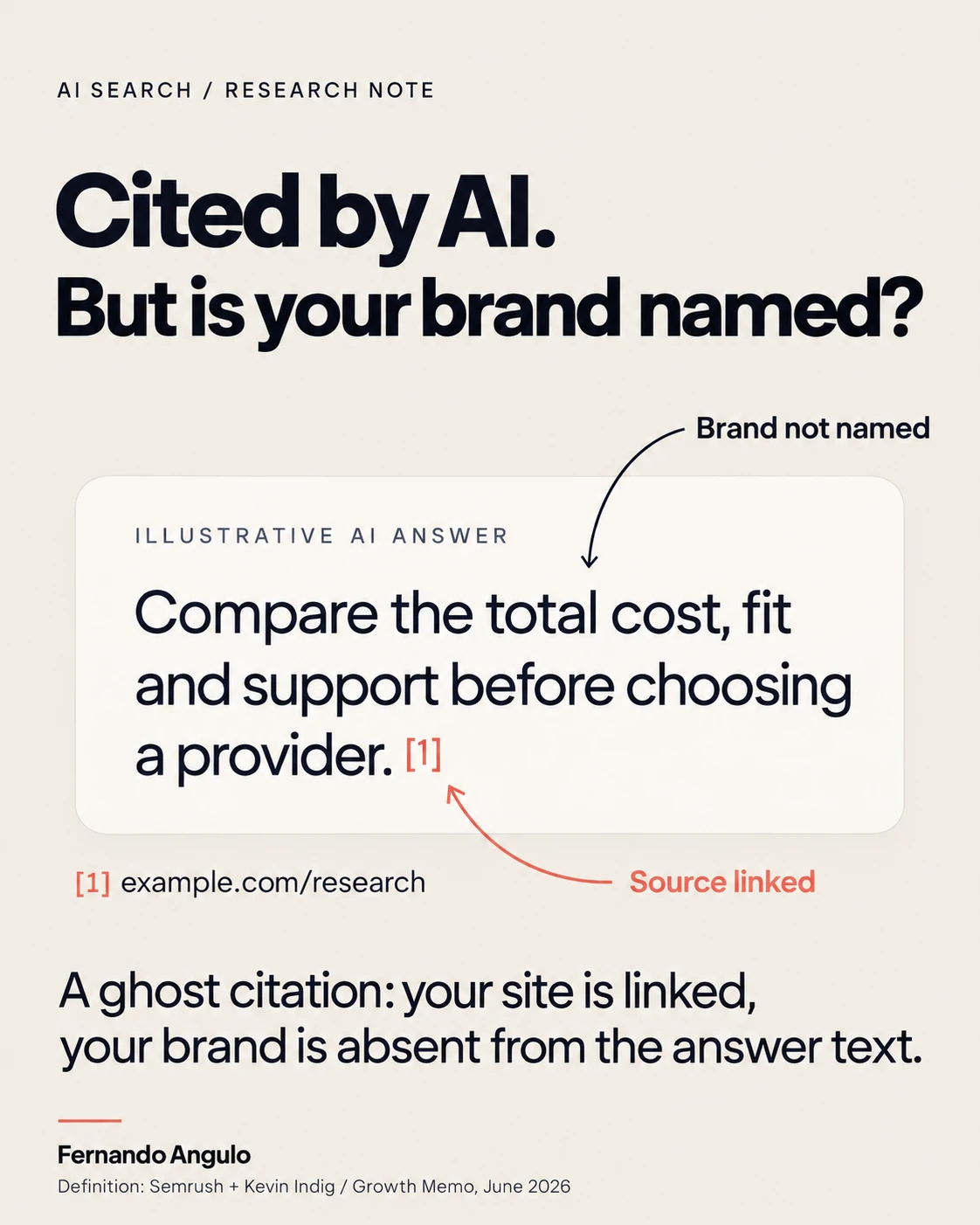
Illustration, not a captured AI response.
Semrush’s finding concerns observed appearances
Semrush published its study on June 9, 2026, using 3,981 domain appearances across 115 prompts, 14 countries, and four platforms: ChatGPT, Gemini, Google AI Mode, and Google AI Overviews.
| Outcome | Share of observed domain appearances |
|---|---|
| Cited without a brand mention | 61.7% |
| Cited and mentioned | 13.2% |
| Mentioned without a citation | 25.1% |
Use observed domain appearances as the denominator, as in the detailed breakdown. The headline’s “62% of AI citations” wording is less precise. The study measures citations and mentions, not recall, clicks, or purchases.
Source: Semrush research with Kevin Indig and Growth Memo.
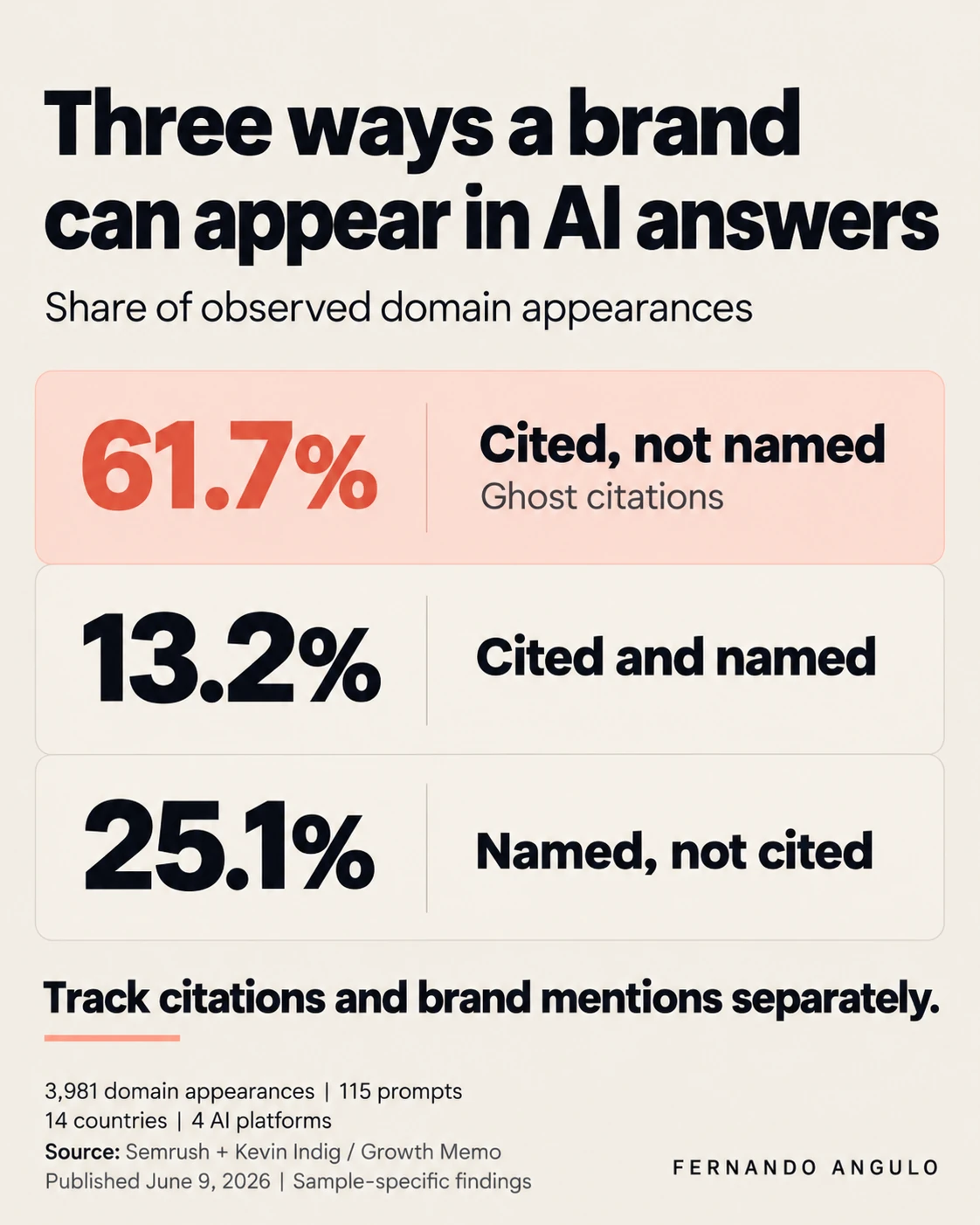
Data: Semrush research, published June 9, 2026. Sample-specific findings.
The implication for reporting is practical: inspect the name in the answer alongside the source link before selecting an intervention. Keep visits and qualified business outcomes in separate records.
A contrast from my own website
In separate source-directed checks, Perplexity and ChatGPT both linked my conference guide and named Fernando Angulo. Those were cited-and-named observations. The URL was supplied, so neither check establishes unaided discovery. They illustrate how to distinguish a ghost citation from a response with explicit attribution.
No fresh check confirmed a ghost citation of my site. The worked record below uses the Perplexity observation; the methodology retains the other outcomes and conditions.
Start with a manual audit
A small manual review can precede paid monitoring. Choose a few questions connected to an actual buyer decision, such as:
- Which providers meet our implementation requirements?
- How do the relevant alternatives compare for our use case?
- What should we verify before choosing a provider?
These are starting prompts to adapt, not a statistically sufficient sample. Keep wording, platform, language, and market settings stable when comparing later observations. Identify any prompt that supplies your brand or website as a separate condition.
Open each answer and its source list. Record the exact cited URL, the name in the prose, whether the answer presents your company as a suitable option, and any material factual error. Save the answer evidence before classifying it. Account names, source titles, and navigation labels are not answer-prose mentions.
Here is a completed record from my source-directed Perplexity check. The observation is real; the next action, owner, and review condition are proposed workflow choices.
| Field | Completed example |
|---|---|
| Observation | My conference guide was cited and Fernando Angulo was named |
| Source | fernandoangulo.com/blog/ai-search-geo-conferences |
| Classification | Cited and named; URL supplied in the prompt |
| Interpretation | Visible attribution in this response; unaided discovery remains untested by this check |
| Proposed next action | Retain the page on this evidence; use unbranded buyer questions if evaluating discovery |
| Suggested owner | Search or content lead |
| Review condition | Revisit if a discovery decision needs evidence or a comparable run reveals an attribution or accuracy issue |
Download the audit worksheet, including this example and a blank record.
Share the findings with the reporting or content lead. Here, the supplied page was cited and named, so this response gives no reason to change its attribution. Testing discovery without a supplied URL would be a separate task.
Add monitoring when a repeated decision needs it
Semrush’s October 7, 2026 guide documents a Sources report within Prompt Tracking, with cited domains and pages alongside brand mentions in associated answers. Visibility Overview provides a broader database view.
Source: How to track AI citations and sources with Semrush.
Use a tool when collecting the same observations repeatedly becomes useful to a decision. Inspect associated answers and preserve the report’s filters. A competitor’s cited page in an answer that omits your brand is a competitive observation, not a ghost citation of your website.
For a larger program, define the denominator before reporting a rate. Citation-only appearances divided by all observed brand/domain appearances describes the outcome mix. Dividing them by appearances with an owned-domain citation answers a different question about attribution among cited appearances. Neither is automatically a percentage of all tested answers.
Continue when observations can inform an editorial correction, a source investigation, or a reporting change. Adjust the question set if it misses the buyer decision. Defer a larger measurement program when no decision depends on it, or when relevant answer evidence is unavailable. More collection is not automatically more useful.
Bring one defensible decision to the next review
The search or content lead should be able to show the marketing leader a relevant answer, its sources, the classification, and a proposed next step. A factually wrong description may warrant a correction. A clearly attributed research citation may warrant leaving the page alone. Absence from a buyer question may warrant investigating which other sources answer it.
Before your next visibility report, complete one audit record for a question that matters to your buyers. Use it to decide what to investigate, change, or leave unchanged.
Methodology and retained test details
The first three exploratory checks used Perplexity Search in my existing signed-in account on October 16, 2026, each in a new conversation. I did not set a controlled market or independently verify the underlying model version. A later interface view displayed a free preview of advanced search; this was not a controlled comparison of product modes. These checks illustrate classification, not a website or market rate.
Check 1: unbranded conference discovery
Prompt: Which AI search and GEO conferences in Europe in 2026 are relevant for B2B marketing leaders? Explain how to choose between them and cite your sources.
Observation: my domain was not in the observed source list. Record retained for this check.
Check 2: source-directed comparison
Prompt: Using https://fernandoangulo.com/blog/ai-search-geo-conferences as a source, explain how a B2B marketing team should choose between an executive marketing conference and a specialist AI search event. Cite the page you use.
Observation: the page was linked and Fernando Angulo was named. Record retained for this check.
Check 3: unbranded measurement question
Prompt: How do citation authority and topic ownership differ in AI search, and how should a marketing team measure each? Cite sources.
Observation: my domain was not in the observed source list. Record retained for this check.
Additional checks and historical evidence
ChatGPT also linked the supplied conference guide and named me in an unpersonalized Temporary Chat with the visible power setting Medium. The first attempt returned a loading error and was not scored; the retry completed. The exact model identifier was not independently verified.
Two further unbranded ChatGPT questions covered choosing between GEO, AEO, and agentic search optimization, and using conference audience questions for market research. A fresh Perplexity question repeated the historical speaker-discovery prompt. None surfaced an identifiable owned-site citation or named me in the observed answer/source region. These deliberately chosen topics are exploratory checks, not a representative panel.
An August 4 panel note records an earlier Perplexity citation of my directory without a Fernando mention. The original raw answer was not recovered, and the fresh speaker-discovery check did not reproduce that result, so it is not used as the article’s confirmed example.
Separate Semrush domain check
Visibility Overview displayed zero citations and zero cited pages with Worldwide, All AI platforms, and October 15, 2026 selected. This database view did not provide a ghost-citation example. It is separate from the manual checks and is not proof that no citations exist elsewhere.
Frequently asked questions
It is an owned-site source link without the brand being named in the answer text. The definition concerns visible attribution, not proof of internal model behavior.
A reader might open the source or recognize its domain. Measuring recall or commercial impact requires evidence beyond the citation and answer text.
An answer can name a company as a competitor, an example, or the subject of criticism. Record separately whether it presents the company as a suitable choice for the buyer’s task.
Referral analytics alone cannot show the full answer and source list someone saw. Use direct answer evidence to classify citations and mentions, then keep identifiable visits in a separate record.
Set the objective by the page’s job. A research page and a product comparison may serve different reader decisions; a citation can be relevant without justifying a rewrite.
You can classify a small set of answers manually with the worksheet. Consider monitoring when repeated collection serves an ongoing decision, with consistent prompts and documented conditions.