 FA
FA
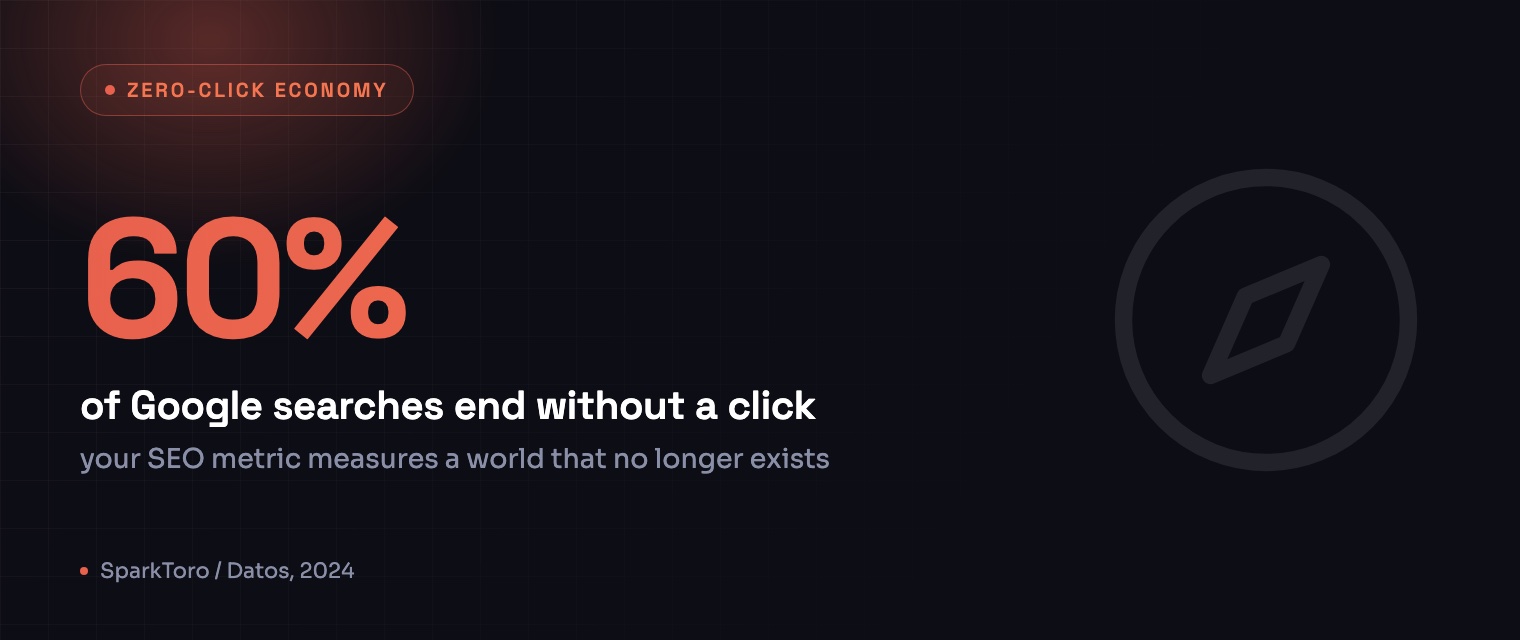
Quick answer:A 2024 Datos and SparkToro study found that 58.5% of US Google searches and 59.7% of EU Google searches produced no click. Sessions still measure visits and on-site outcomes, but they do not capture all visibility delivered on search and AI answer surfaces.
I use the Zero-Click Economy to describe a simple reporting problem: search can create visibility without creating a visit. The decision is not to abandon organic traffic. It is to measure the discovery that sessions miss.
Organic sessions are measuring a world that no longer exists
For 15 years, SEO was sold internally with a clean metric: organic sessions → attribution → revenue. It was a clean story, defensible in any boardroom, and static enough to build a budget on.
Featured snippets, knowledge panels, direct answers, AI Overviews, and conversational systems can satisfy or reshape a query before the user visits a site. The 2024 Datos and SparkToro benchmark confirms that a majority of the Google searches observed in the US and EU sent no click to the open web.
The consequence is concrete: a traffic decline can mean lost demand, more on-SERP resolution, or both. Sessions alone cannot tell you which explanation is true.
That is not the end of SEO. It is the end of using one metric to explain the whole discovery journey.
The mechanism: search value is delivered before the click
The mechanism is structural, not cyclical. When Google answers directly, when ChatGPT cites without linking, when Perplexity synthesizes sources, the value of the query is delivered on the answer surface itself. The brand or source that shows up in that answer captures attention, citation, and category association, without the user generating a measurable session.
I call this the Zero-Click Economy: the part of search where information, attention, or category association can be delivered before a visit. A citation is one observable signal. It is not a substitute for every business outcome.
In this model, a brand can win in two economically readable ways:
1. Be visible on the answer surface. Record whether the engine mentions the brand, cites the domain, or links to a page. Then test whether that exposure moves branded search, direct visits, or another observable outcome.
2. Be the task destination. When a visit occurs, measure the action and intent it carries. Do not assume that a lower click volume means lower value per visit.
Organic sessions remain essential for on-site behavior. They become misleading only when the report treats them as the complete measure of search discovery.
The shift is easiest to see when the existing metric and the missing measure are placed side by side:
| Dimension | Organic session as primary KPI | Zero-Click Economy framework |
|---|---|---|
| Success unit | The site visit | The citation or mention |
| Where value is delivered | On your page, after the click | On the answer surface, before the click |
| What it captures | Conversion, once intent is decided | Discovery, attention, and category association |
| Primary metric | Organic traffic | Citation rate, brand mention, enriched SERP impressions, assisted conversions |
| Blind spot | Misses value delivered with no measurable session | Requires new ownership and reporting discipline |
The reframe. SEO didn’t die. The organic session as primary KPI did.
The framework: four metrics to add beside organic traffic
The reporting mistake is asking one KPI to explain discovery, attention, visits, and conversion. Use four complementary measures beside sessions. Each answers a different management question.
1. LLM citation rate
LLM citation rate is the share of tested generative answers that cite your domain. Track mentions separately. Use a stable prompt set across the same relevant platforms, accounts, locales, and dates, and preserve the outputs and URLs.
Start with a stable, versioned prompt set and preserve the answer, cited URL, platform, date, locale, and whether the brand was merely mentioned or actually cited. A trend is only defensible when the collection method stays comparable.
2. Brand mention in generative answers
The qualitative counterpart to the quantitative metric. It’s not enough for a model to mention you: context matters. I distinguish four mention types: as authority (“the category is led by X”), as example (“companies like X do this”), as alternative (“other options include X”) and as negative (“unlike X, which struggles with…”).
A high presence rate can hide weak positioning when most mentions present the brand as a secondary alternative. Count the appearance, then classify the context.
3. Enriched SERP impressions
Track impressions and owned observations for featured snippets, knowledge panels, People Also Ask, and AI Overviews where the platform exposes them. Document the collection method because reporting support differs by surface.
This is the bridge between classic SEO and Answer Engine Optimization (AEO). It shows where the brand appears before the click. It does not show what caused the appearance.
4. Assisted conversions from discovery
Assisted conversions from discovery are conversions where the first identifiable touchpoint was a discovery surface, not a direct session. This is the most political metric of the four, because it forces the analytics team to redefine what counts as a touchpoint in a world where discovery can happen in a conversation with an LLM that leaves no referrer.
Use this layer to test lead-lag relationships between answer visibility, branded search, direct traffic, and conversion. A correlation can guide the next analysis. It cannot prove that the answer caused the outcome.
The four metrics in one line. Citation rate counts. Brand mention qualifies. Enriched SERPs anticipate. Assisted conversions justify.
The evidence: what I see when I audit LLM visibility
The strongest public evidence here is behavioral. The Datos and SparkToro study measures no-click Google searches, while a Pew Research Center browsing study found users clicked a traditional result in 8% of visits with an AI summary, compared with 15% without one. Only 1% clicked a source inside the summary. These studies use different samples and definitions, so they support the direction of change, not one universal zero-click rate.
AI visibility benchmarks should be reported with their prompt set, platform coverage, geography, date range, and definition of mention versus citation. Without that information, percentages from private audits are observations, not market estimates.
Where the argument breaks: when the organic session still wins
Not all search is zero-click. Some categories still have the click as the central unit: transactional e-commerce, local search with immediate intent, geolocated services, high-spec products where the user needs to compare datasheets. In those categories, the organic session still captures a fair share of value.
Even in those categories, discovery can occur before the click. A user may arrive after consulting an AI answer that leaves no referrer. Organic sessions measure the visit and on-site outcome. They do not reveal every prior exposure.
The implication: the conversation to have this quarter
The operational decision to make before the quarter closes isn’t technical. It’s governance.
The first barrier is ownership. A spreadsheet can establish a baseline, but someone must define the prompts, preserve the outputs, review the context, and defend what the number does and does not mean.
Two moves I recommend to CMOs at this point:
First, assign explicit ownership of AI visibility to an existing role (head of SEO, head of brand, head of content; what matters is that it has a name, not a new title). Without an owner, no metric survives two quarters.
Second, add one metric to the next report, not all four. Start with separate mention and citation rates across a fixed prompt set. That creates a baseline without pretending to replace the entire measurement system.
Starting now creates a baseline for later comparison. It does not guarantee a durable lead, because citation behavior, models, and competitors can all change.
The Reporting Decision
Keep organic sessions. Add mentions and citations as separate lines for one stable prompt set. Not a replacement dashboard. A more honest account of discovery.
Frequently Asked Questions
The Zero-Click Economy is the phase of search where the value of a query is delivered before the click. AI Overviews, generative answers, featured snippets, and knowledge panels resolve user intent directly on the search surface. In this model, the success unit is no longer the session, it’s the citation or mention received at the moment of maximum attention.
Organic sessions measure visits. The 2024 Datos and SparkToro study found no click in 58.5% of US and 59.7% of EU Google searches. Sessions remain useful for on-site outcomes, but alone they miss visibility delivered on the search or answer surface.
Four complementary metrics: citation rate in LLMs (% of generative answers that cite you), brand mention in generative answers (context and type of mention), enriched SERP impressions (AI Overviews, featured snippets, knowledge panels), and assisted conversions from discovery (conversions whose first touchpoint was a discovery surface).
No. Search accessibility, crawlability, useful pages, and links still matter. Answer visibility adds another measurement surface. Its relationship to traditional search differs by platform and should be observed rather than assumed.
Keynotes on the Zero-Click Economy and AI Search
Available for talks on how to measure SEO and brand visibility in the era of generative answers.
Sources checked in this revision
Google’s official AI-search guidance · Generative AI performance reporting · Semrush AI Visibility Index, June 2026
Data update: September 2026
SparkToro’s Similarweb analysis estimates that 68.01% of US Google searches in January–April 2026 ended without a click. This is a desktop and mobile panel estimate. It is not directly comparable with the 2024 Datos sample and does not establish satisfaction or lost revenue.
Read the source and methodology