 FA
FA
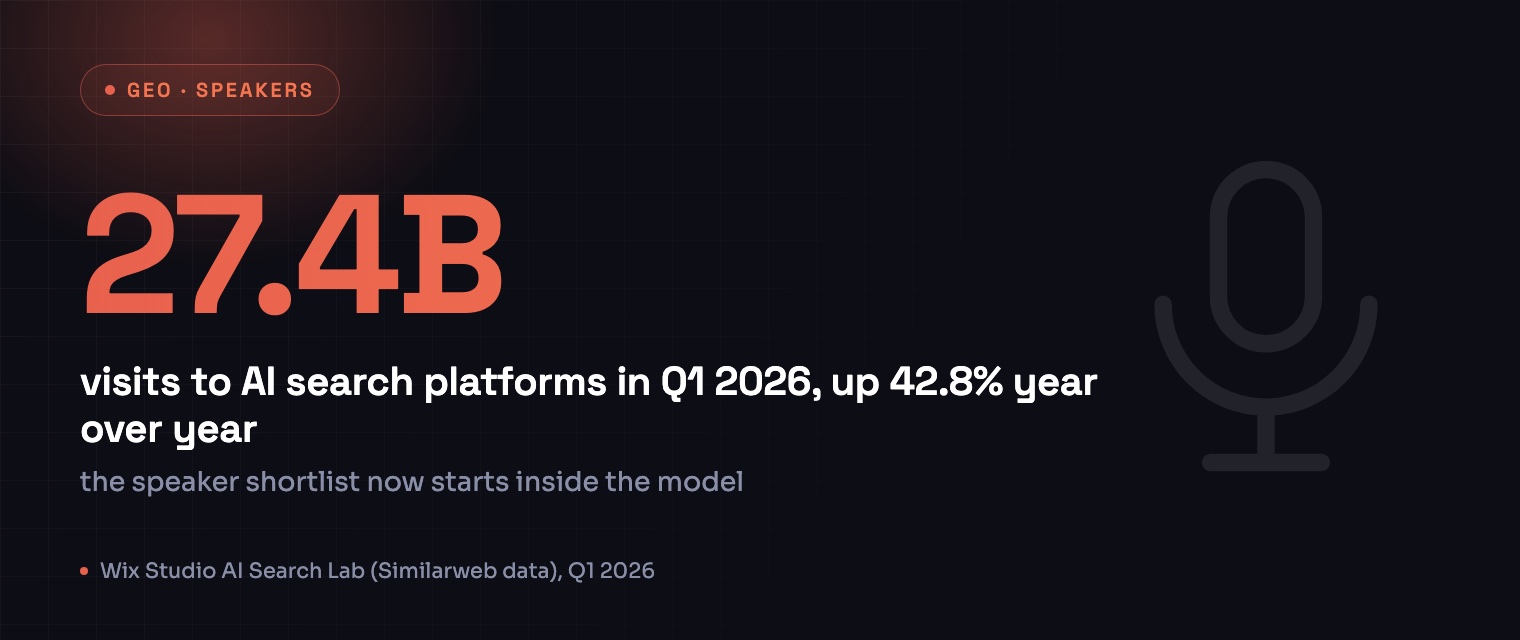
Quick Answer:GEO for speakers is the practice of making a speaker's public record easy to identify, interpret, verify, and cite when an organizer asks an AI system for recommendations. The light diagnostic is the Shortlist Test: 8–10 organizer-style prompts that reveal obvious gaps. The field experiment is different. It fixes five intents, four platforms, and three repetitions for 60 planned responses at each checkpoint. The four working layers remain Discoverability, Clarity, Authority, Trust.
The decision is narrower than the category
An AI system can connect a person to a precise brief while failing to connect that person to the general category. That is the tension this case measures. The baseline shows a stronger association when the prompt asks for a research-led briefing for B2B CMOs or a booking option, and no association when the prompt only asks the system to define the category.
This is not a success story. It is a dated starting point for testing whether public evidence changes a person-to-category association. If you are building your own panel, the practical measurement framework is in How to Measure a GEO Campaign. If you are evaluating the talk itself, use the GEO keynote brief rather than an AI mention as proof of fit.
Run the Shortlist Test
The Shortlist Test is a light diagnostic: 8–10 organizer-style prompts, scored for mentions and citations separately. It is useful for finding an obvious gap before designing a heavier study. It is not the field experiment and it is not statistically representative.
- “Best keynote speakers on [your topic]”
- “[Topic] speaker for a CMO summit in [your region]”
- “Who speaks about [your topic] in [language]?”
- “Alternatives to [the famous name in your category] for a corporate event”
- “Keynote speaker who covers [topic A] and [topic B] with original research”
Score being named, recommended, cited, prominent, and factually accurate as separate signals. A page can be cited without the person being recommended. The distinction between retrieval and recommendation is explained in Why Citation Authority Matters More Than Rankings in AI Search.
The 60-day field experiment
Research question: across a fixed panel, is Fernando more strongly associated with the concrete decision “research-led AI search keynote speaker for B2B CMOs” than with the general category “AI search keynote speaker,” and does that association change after dated public interventions?
Design: five intents (Define, Compare, Alternatives, Use case, Buy) across four platforms (ChatGPT, Perplexity, Gemini, Google AI Mode), with three repetitions per intent and platform. That produces 60 planned responses per checkpoint. Prompts are unbranded and each run starts context-free. The record preserves settings, platform and model, market, language, date, repetition, status, exact evidence, and exact cited URLs. The five intents are a decision-spanning coverage heuristic, not a statistically representative sample.
Locked baseline, 2026-09-01
| Cut | Valid responses | Fernando mentions | Mention share |
|---|---|---|---|
| Total | 60/60 | 11/60 | 18.3% |
| ChatGPT | 15/15 | 7/15 | 46.7% |
| Perplexity | 15/15 | 3/15 | 20.0% |
| Gemini | 15/15 | 0/15 | 0.0% |
| Google AI Mode | 15/15 | 1/15 | 6.7% |
By intent, the locked panel recorded Define 0/12, Compare 1/12, Alternatives 2/12, Use case 4/12, and Buy 4/12. Median prominence was position 1 among mention responses; position 1 means the first named or recommended appearance. Of the 11 mention responses, 10 attempted at least one canonical Fernando fact. Nine of those 10 attempts were accurate, so factual accuracy was 9/10 scored responses, or 90.0%. The accuracy denominator includes only responses that attempted a canonical fact.
For this case, the single-platform local rule requires Fernando to be named or recommended across at least 4/5 intents on that platform, have the highest mention share, and rank at least 5 percentage points (pp) above the runner-up. A percentage-point lead is the difference between two percentage rates. The locked baseline found that 0/4 platforms met the single-platform local rule. That is not an ownership finding. Full portfolio ownership also requires repeatability across consecutive checkpoints and independent person-to-category corroboration.
Observation: the association was stronger for Use case and Buy and absent for Define. Boundary: this is one person's fixed diagnostic panel, affected by platform, session, language, market, and date. It does not show that any content caused an answer, and it does not estimate the speaker market.
The original capture did not preserve a durable exact-URL export for every source drawer. Owned citation percentage is unknown and cannot be reconstructed. Independent citation percentage is unknown and cannot be reconstructed. Neither value should be recorded as 0%; both remain unknown.
This case uses a case-specific mapping of the general control taxonomy: Fernando-owned maps to entity-controlled, employer-controlled maps to affiliated-controlled, and organizer-controlled maps to host/partner-controlled. The six case classes are Fernando-owned, employer-controlled, organizer-controlled, editorially independent, commercial directory, and unrelated. Semrush is employer-controlled for Fernando, not independent. An independent article about the topic is still not person-to-category corroboration unless it supports that association.
The four layers, applied to a speaker
The working model has four layers: Discoverability, Clarity, Authority, Trust. They organize the evidence without assuming that one universal ranking formula applies across platforms.
1 · Discoverability, can the machine find a consistent you?
Make the speaker entity easy to resolve across public records.
- One canonical name spelling, job title, and affiliation string everywhere, site, LinkedIn, event pages, podcast notes.
- Person schema with
sameAslinks tying your profiles into one entity. - A maintained canonical profile that states who you are in plain text.
2 · Clarity, can the machine quote you cleanly?
State the topic, audience, and decision in language another page can reuse accurately.
- A speaker page that answers, in extractable sentences: topics, formats, languages, regions, proof.
- A clear distinction between an AI search, general AI, and SEO keynote.
3 · Authority, does anyone else say it?
Record who controls each source and what claim it actually supports. A host page can verify a session. An editorial profile can provide independent person-to-category corroboration. They are not interchangeable.
- Event recaps naming you, live conference speaker pages, podcast appearances, industry-press quotes, each is a corroborating domain.
- Preserve the public URL and publication date for each artifact.
- Do not label affiliated or partner-controlled evidence as independent.
4 · Trust, is it fresh and verifiable?
Keep facts current and verifiable. This is an editorial control, not a claim about a universal platform ranking rule.
- Dated testimonials with full names and roles.
- A maintained past-events list.
- A source on every stat you publish.
The stage-to-citation loop
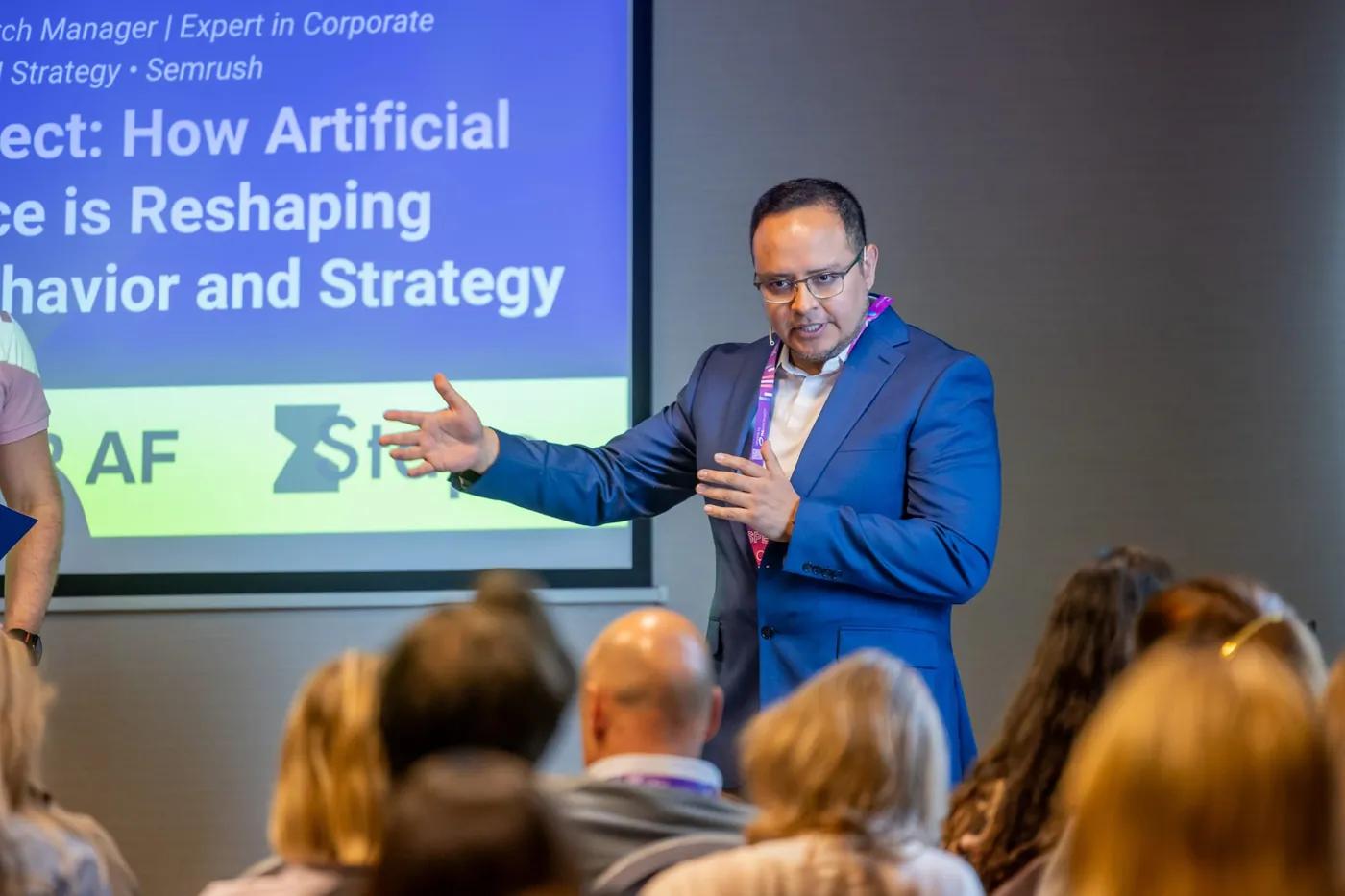
A talk becomes measurable evidence only when its public artifacts identify the speaker, topic, audience, claim, date, and source. The stage-to-citation workflow is one way to create and maintain those records. It does not guarantee that a platform will retrieve or use them.
The experiment logs each public intervention by date, asset, control, intent, URL, and days exposed. That ledger matters because a later answer may cite a new page without supporting the target association, or may change without citing any intervention at all.
Limits and next checkpoints
The five-intent panel is deliberately narrow. It can compare the same decision territory over time, but it cannot represent every organizer, market, language, model, or session. A mention is not evidence that the talk is good. A citation is not evidence that the person was recommended. A change after publication is not proof of causation.
The complete 30-day panel and internal review are scheduled for 2026-10-01. The complete 60-day panel is scheduled for 2026-10-31. No checkpoint value is published here before the fixed panel, exact cited URLs, source classes, and calculations are reviewed. A flat or negative result remains publishable evidence after approval.
If you book speakers rather than compete as one, use How to Pick an AI Keynote Speaker to evaluate the shortlist. The model output is a research input, not a verdict. The speaking overview provides the human evidence needed to assess audience fit.
Frequently Asked Questions
GEO for speakers is the practice of making a speaker's public record easy to identify, interpret, verify, and cite when an organizer asks an AI system for recommendations.
The locked 2026-09-01 panel captured 60/60 valid responses and 11/60 Fernando mentions (18.3%). By platform: ChatGPT 7/15 (46.7%), Perplexity 3/15 (20.0%), Gemini 0/15 (0.0%), and Google AI Mode 1/15 (6.7%). By intent: Define 0/12, Compare 1/12, Alternatives 2/12, Use case 4/12, and Buy 4/12. Median prominence was position 1; factual accuracy was 9/10 (90.0%); 0/4 platforms met the single-platform local rule. This is a baseline, not evidence of improvement.
Run the Shortlist Test with 8–10 organizer-style prompts and score mentions and citations separately. Use it as a light diagnostic, not as a statistically representative field result.
The field experiment fixes five intents, four platforms, and three repetitions for 60 planned responses at each checkpoint. It preserves settings, market, language, date, repetition, status, evidence, and exact cited URLs.
The owned and independent citation percentages are unknown because exact URLs were not durably retained for every historical source drawer. Neither value should be recorded as 0%; both remain unknown.
No. Semrush is employer-controlled evidence for Fernando, not independent. Source class is based on publication control, not perceived authority.
Bring the evidence and its limits to your audience.
This keynote turns AI-search visibility into a decision framework for senior marketing teams.
Method and scope
The public baseline is a first-party field record locked on 2026-09-01: one named person, five decision intents, four platforms, three repetitions, 60 valid responses, English-language prompts, and the United States and Europe buyer context. Read the public measurement method and the citation-authority distinction.