 FA
FA
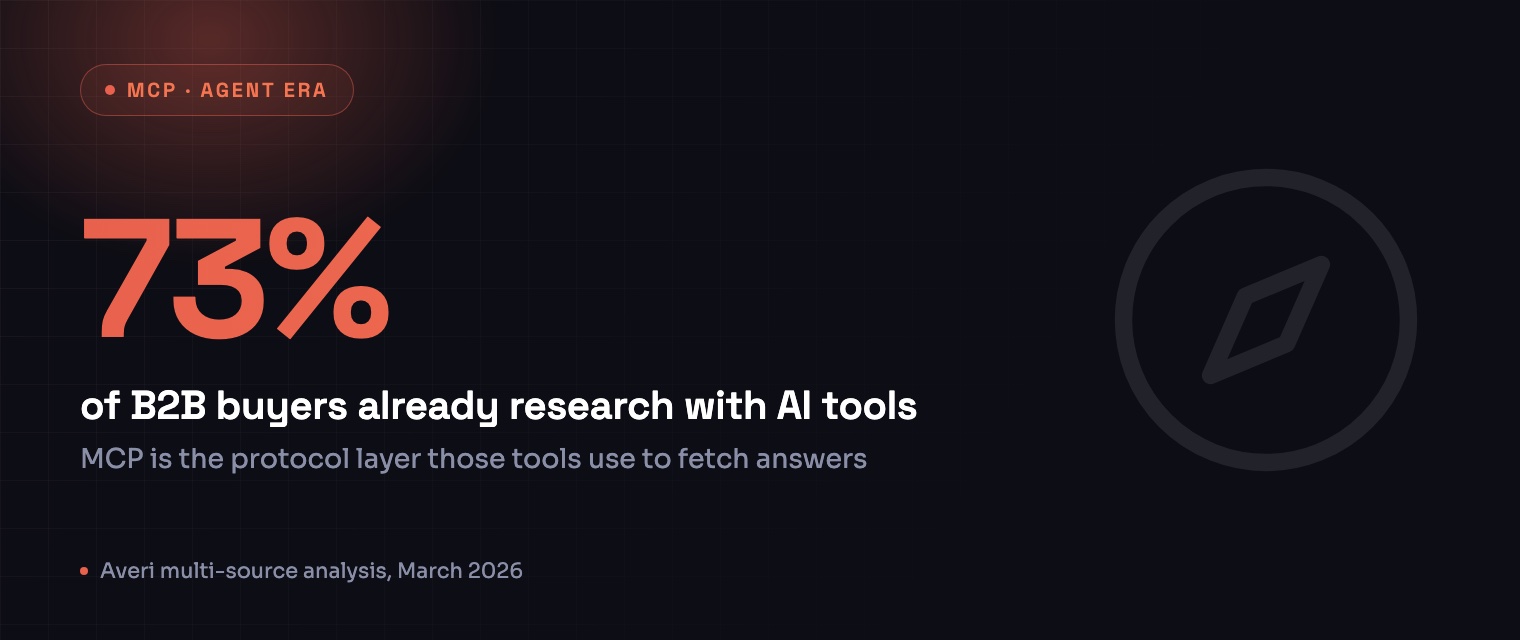
Quick Answer:The Model Context Protocol (MCP) standardizes how an AI client connects to tools and data sources. For marketers, it creates a new authorized information surface alongside the public web. It does not replace SEO or guarantee a recommendation. Start with one useful task and test whether the client receives the right information.
Anthropic published MCP as an open standard in late 2024. Support has since expanded across AI clients and development tools, but access, permissions, and implementation still vary. One protocol. Many operational realities.
What MCP Actually Does
Think of MCP as a shared connector for AI. A compatible client can discover tools exposed by a compatible server and use them within the permissions granted. The source might be a database, API, documentation system, or CRM.
That creates another retrieval route. An authorized client can query a structured source instead of relying only on public webpages. The website remains part of discovery. MCP adds access; it does not erase the web.
The Brand Visibility Implications
Three shifts matter for marketers.
First, an authorized data connection creates a different surface. An AI client using MCP can query tools or data exposed by a server without relying only on public webpages. That can improve task completion for a defined use case. It does not make the public website irrelevant and it does not guarantee that the brand will be cited or recommended.
Second, task completion becomes a separate outcome. A connected client may compare options, retrieve account data, or execute an approved action. Measure whether your information helps complete that task. Do not confuse access with preference.
Third, permissions and capability descriptions become visible marketing inputs. A tool name, description, parameter, and approval rule shape what the client can do. Keep those facts accurate and consistent with the product. This is where marketing, product, security, and agent-readiness meet.
Why the Timeline Matters
MCP support is expanding, but it is not uniform. OpenAI describes full MCP support as a beta capability with availability and permissions that vary by plan. The practical question is not whether every buyer is already using MCP. It is whether a relevant client can access a useful, authorized capability safely.
The timeline depends on the client and task. Do not launch an MCP server because adoption forecasts create urgency. Launch a bounded pilot when connected access removes real friction for a user you can identify.
What to Ship in the Next 90 Days
Five concrete actions, in decision order.
1. Select one bounded task. Define the exact information or action an AI client needs, the user who benefits, and the result that counts as success.
2. Audit product and identity facts. Names, roles, capabilities, prices, and limits should agree across the properties you control. The wording can vary. The underlying fact cannot.
3. Expose product surface in machine-readable formats. If you sell software, publish an OpenAPI specification. If you sell physical goods, publish structured product feeds with availability and pricing. If you offer services, publish structured case-study data with explicit outcome metrics. Tell agents what they can act on, not just what they can read.
4. Put the answer near the beginning of each important page. Make the central claim, source, and date easy to extract, then test retrieval in the target system. Do not rely on a universal token threshold.
5. Test permissions and failure states. Use minimum access, explicit approval points, accurate tool descriptions, and monitored test cases. A useful connection must also fail safely.
The Next Test
Choose one task a customer already struggles to complete. Expose only the data and action it needs, add an approval point, and measure accuracy. Not a protocol launch. A safer customer outcome.
Frequently Asked Questions
MCP, or Model Context Protocol, is an open standard published by Anthropic that lets AI assistants connect to external data sources, tools, and services through a uniform interface. Instead of every AI application building bespoke integrations one-by-one, MCP defines a shared protocol, analogous to how USB standardized hardware connections, so any MCP-compliant AI client can use any MCP-compliant data source.
MCP gives an authorized AI client another route to tools and business data. That can improve a defined customer task, but access does not guarantee a recommendation or replace the public web. Keep product facts and capability descriptions accurate, then test the target client.
MCP matters when an organization wants an authorized AI client to access specific tools or data. Support is expanding, but availability and behavior vary by platform and plan. MCP access does not guarantee recommendation or citation.
Choose one bounded use case, expose only the minimum required data or action, define permissions and human approval points, test result accuracy, and monitor failures. A product feed or documented API may be more appropriate than MCP for some public use cases.
Speaking on MCP and AI brand visibility
Available for keynotes on the practitioner playbook for the agentic-AI era.
Sources checked in this revision
Google’s official AI-search guidance · Generative AI performance reporting · Semrush AI Visibility Index, June 2026