 FA
FA
Quick Answer:Agentic Search Optimization (ASO) prepares content, data, permissions, and capabilities for AI systems that retrieve information or complete an authorized task. SEO helps people and systems find the page. Generative Engine Optimization (GEO) measures whether an AI answer uses the source. ASO tests whether an agent can interpret the information and act within defined limits.
Search pages now serve two users: the person making the decision and the system helping with the task. The same source must remain persuasive to one and unambiguous to the other.
That adds an operational layer to SEO and GEO. Product facts need a reliable route, permissions need boundaries, and capabilities need tests. This is not proof that agents have replaced buyers. It is a reason to stop treating machine access as someone else’s problem.
For a stage-ready version, the Agentic Search Optimization keynote brief maps the five layers to the decisions a senior marketing audience needs to make next.
The Buyer Profile Has Already Changed
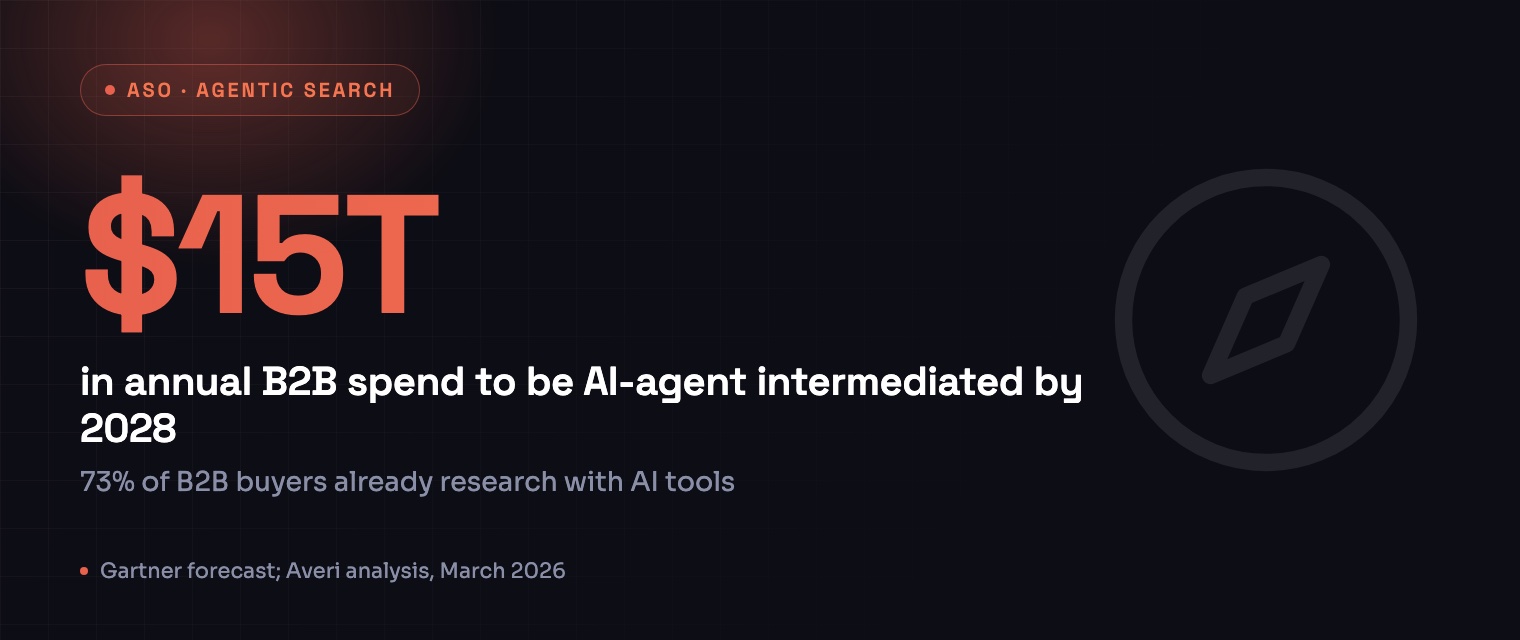
The strongest public signals are forecasts, not proof of universal buyer behavior. Gartner predicts that 40% of enterprise applications will include task-specific AI agents by the end of 2026, up from less than 5% in 2025. Forrester predicts that 20% of B2B sellers will face agent-led quote negotiations in 2026.
Those figures justify preparing product data, permissions, and interfaces for machine use. They do not establish that most B2B research is already autonomous, or that agent-ready brands will receive a guaranteed visibility advantage within a fixed window.
The readiness problem: agent capabilities are entering enterprise software faster than most organizations can establish reliable product data, permissions, evaluation, and governance.
Two SEOs, One Site
A person needs context, proof, and a clear next step. An agent needs accessible facts, supported capabilities, and permission to act. Neither requirement cancels the other.
Design the page for the person. Structure the underlying information so an authorized system can interpret it correctly. Same page. Two forms of access.
| Dimension | SEO | GEO | ASO |
|---|---|---|---|
| Who it optimizes for | A human who browses ranked results | An AI model generating an answer for a human | An autonomous AI agent executing a task |
| What that reader wants | Persuasion, design, narrative, social proof | A clear, synthesizable answer to cite | Structured data and capability signals it can act on |
| Surface that matters | Visual design and persuasive copy | Direct-answer content and entity clarity | APIs, structured data, machine-readable trust signals |
| Unit of success | A click through to your site | A citation inside the generated answer | The agent acting on your data, often without a click |
What AI Agents Actually Do When They “Browse”
Start with the route the agent actually uses. It may never load the page in a conventional browser.
An agent may use a search index, browser, connector, API, product feed, or other authorized tool. There is no universal retrieval order. Audit the actual interfaces your target agent can access and test the information it receives from each one.
Dense, parseable, attributed content makes retrieval and verification easier. Poorly exposed information can be missed, misread, or replaced by a third-party description. The practical response is to test the actual interfaces your target system uses instead of assuming every agent reads a site in the same way.
A useful editorial principle is to state the answer early and keep technical documentation focused. Treat token counts as design constraints to test, not universal limits: context allocation varies by model, tool, task, and implementation.
The Five Layers of Agent-Readable Content
This is the practitioner framework I work with when auditing a site for ASO readiness. It is structured deliberately to map onto the agent’s decision sequence: discover → parse → budget tokens → verify capability → trust.
Layer 1, Discoverability
Before an agent can use information, the system operating it needs an authorized route to that information. That may be an indexed webpage, a connector, an MCP server, an API, or a product feed. Keep ordinary sitemaps and crawl controls accurate, but verify support for any agent-specific mechanism rather than assuming it is universal.
How to implement: Audit crawl access, sitemaps, connectors, and documented APIs. An llms.txt file can remain an experiment for tools that explicitly support it, but Google says it ignores the file and it should not replace normal web architecture.
Layer 2, Parsability
Agent capabilities vary: some systems inspect rendered pages or screenshots, while others consume text or structured responses. Use accessible structure and test the actual interface and agent; do not assume all agents ignore visual layout.
Treat clear structure, accurate identity and relevant corroboration as maintenance practices. Google does not require special AI markup, and publication frequency does not prove training inclusion or a citation gain.
Layer 3, Token Efficiency
Retrieval systems select limited passages or tool outputs for a task. If the main answer is buried, the system has more opportunities to miss or misread it.
How to implement: Put the main answer near the beginning. Use plain language, attribute claims to specific sources, and include dates when freshness matters. Then test whether the target search or agent system can retrieve the correct claim. Aim for clarity and evidence, not a fixed word or token count.
Layer 4, Capability Signaling
Capability signaling means telling an agent not just what your site says but what your site or product can do. Pricing API endpoints, product feeds, structured availability data, supported integrations, comparison tables in machine-parseable formats. These are the signals that turn an agent from a reader into an actor.
How to implement: Expose the operational surface of your product in machine-readable formats. If you sell software, publish an OpenAPI specification. If you sell physical goods, publish structured product feeds with availability and pricing. If you offer services, structure your case studies with explicit outcome metrics. The principle is simple: tell agents what they can act on, not just what they can read.
Layer 5, Trust Signals
Some search and agent systems corroborate claims across sources. Conflicting names, roles, dates, or product facts can therefore create avoidable ambiguity, although the effect varies by system and query.
How to implement: Run a cross-source consistency audit. Keep names, roles, organizations, dates, capabilities, and other verifiable facts aligned across your site and relevant third-party profiles. Use sameAs only for URLs that identify the same person or organization. Then test whether corrections change retrieval or citation behavior.
What This Looks Like in Practice
Consider a hypothetical mid-size B2B software vendor, a project management platform competing in a crowded space. Their human-facing SEO is competent: keyword research, blog content, comparison pages, paid search support. Their organic traffic from human searchers is solid.
An audit of their ASO readiness reveals a different story. Their pricing page is rendered client-side with no structured data, agents cannot extract pricing reliably. Their integrations page is a beautiful animated grid with no machine-readable list of supported tools. Their CEO’s LinkedIn lists her as “CEO and Founder”; the website calls her “Founder & Chief Executive Officer”; her Crunchbase entry says “Founder.” Three sources, three slightly different identities, enough inconsistency to lower agent confidence in the entire entity.
The audit question is concrete: can the target agent recover the right price, integration list, and company identity from each authorized route? Run the task and record the answer. Do not infer failure from the page design alone.
Fix the failed route first. That may require server-rendered product facts, a documented API, a cleaner feed, or consistent identity data. Scope follows the test result, not a generic ASO checklist.
The Measurement Problem
One honest challenge in ASO is measurement. Traditional SEO has imperfect but real metrics: rankings, organic sessions, click-through rates. ASO measurement is less mature, because the agent layer is less observable than the human layer.
You can track repeated task completion, answer accuracy, citation or mention frequency, referral traffic when a referrer is available, and failures by interface. Keep those signals separate. They do not describe the same behavior.
You cannot observe every agent-assisted journey that produces no visit. That is the measurement gap. Build a small readiness test because the task matters, then connect it to an outcome you can observe. Architecture first. ROI claims after evidence.
The Preparation Gap Is Your Window
The useful measurement is not a market-wide adoption percentage. It is whether the agents relevant to your buying journey can retrieve correct product information, distinguish supported capabilities, respect permissions, and escalate uncertainty to a person.
Measure that readiness now, but do not promise a fixed first-mover window or assume that agent access creates citation preference. Both remain hypotheses to test.
The forecasts make preparation reasonable. They do not make every ASO investment urgent or valuable. Choose one buyer task, one authorized interface, and one success threshold.
Do not build for an abstract agent economy. Prove that the system can use your information correctly.
The Next Test
Give the target agent one representative buyer task. Record which facts it retrieves, which source it uses, and where it stops for approval. That result tells you what to fix next.
Frequently Asked Questions
Agentic Search Optimization (ASO) prepares content, data, permissions, and capabilities for AI systems that retrieve information or complete an authorized task. SEO helps people and systems find the page. Generative Engine Optimization measures whether an AI answer uses the source. ASO tests whether an agent can interpret the information and act within defined limits.
SEO targets a human who browses ranked results and clicks through to a website. GEO (Generative Engine Optimization) targets an AI model generating a synthesized answer for a human reader. ASO targets an autonomous AI agent that is performing a task, research, comparison, procurement, on behalf of a human user, often without that user ever visiting your site. The optimization surface area is different: APIs, structured data, capability signaling, and machine-readable trust signals matter more than visual design or persuasive copy.
The shift is measurable but still emerging. Gartner predicts 40% of enterprise applications will include task-specific agents by the end of 2026, and Forrester predicts 20% of B2B sellers will face agent-led quote negotiations in 2026. These forecasts justify preparation, not the conclusion that most purchasing is already autonomous.
The five audit layers are: discoverability through ordinary crawl and access controls; parsability through clear visible content and accurate structured data; evidence quality through sourced and current claims; capability access through documented APIs or product feeds where relevant; and governance covering permissions, consistency, monitoring, and human review.
Start by validating crawl access, keeping sitemaps and product information current, matching structured data to visible content, documenting supported APIs or feeds, and testing what authorized agents can retrieve and do. Treat llms.txt as an optional experiment, not a standard that major search systems promise to use.
Is your site agent-ready?
I help global enterprises build for the search layer most teams haven’t noticed yet.
Sources checked in this revision
Google’s official AI-search guidance · Generative AI performance reporting · Semrush AI Visibility Index, June 2026