 FA
FA
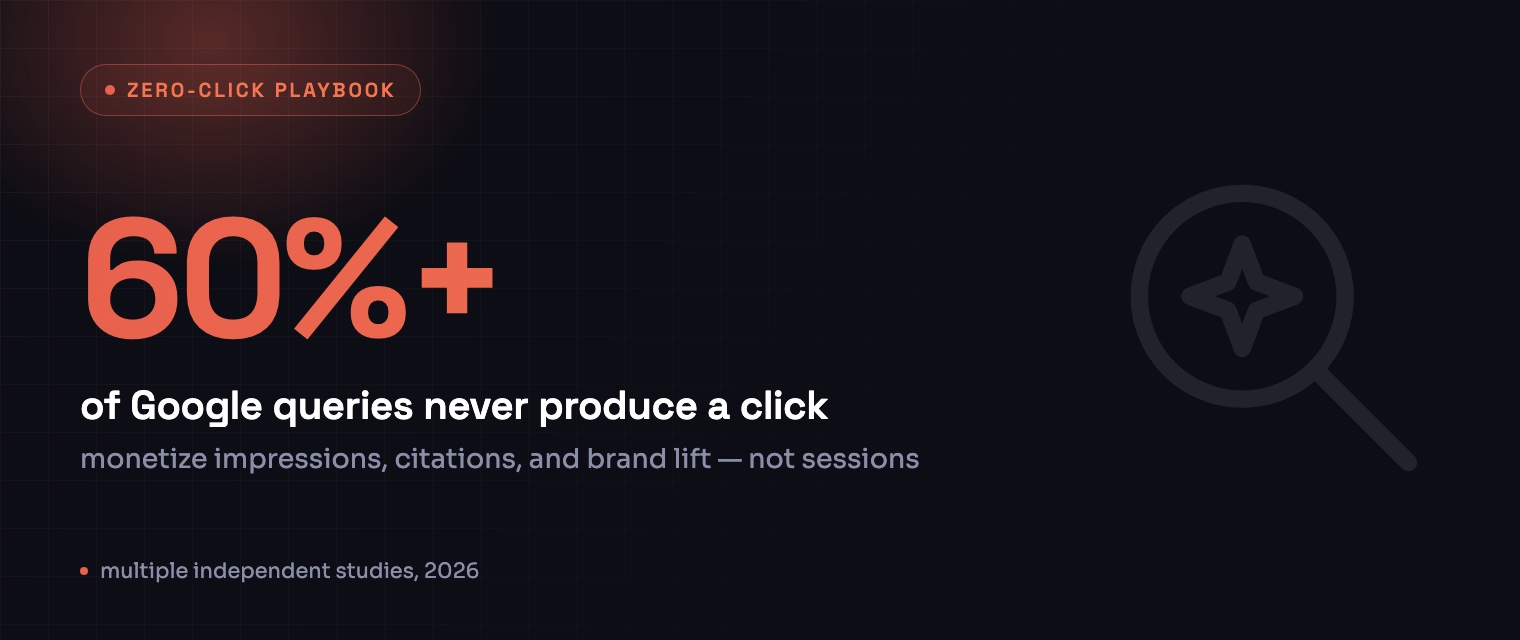
2026 evidence: period and provider
SparkToro’s Similarweb analysis estimates that 68.01% of US Google searches in January–April 2026 ended without a click. This is a desktop and mobile panel estimate. It is not directly comparable with the 2024 Datos sample and does not establish satisfaction or lost revenue.
Read the source and methodologyDevice weighting and session rules are part of the method. No recorded click does not establish that the user found an answer or that AI caused the outcome.
Quick Answer:Zero-click search describes searches ending without a recorded click. A 2024 Datos/SparkToro study estimated this outcome in 58.5% of US Google searches and 59.7% of EU Google searches. Brands should measure share of answer alongside traffic, not treat one as a replacement for the other.
SEO reporting has long centered on rankings, CTR, sessions, and pageviews. Those measures still explain what reaches the site. They do not capture every answer, mention, or impression delivered before a visit.
A Click Is One Outcome, Not the Whole Product
As a historical reference, the 2024 Datos/SparkToro study found: 58.5% of US Google searches and 59.7% of EU Google searches ended without any click. Those are aggregate observations from the markets and period studied, not universal rates for every query class, language, or vertical.
Featured snippets, knowledge panels, People Also Ask, AI Overviews, and conversational AI answer engines can all resolve part of a query before a visit. The effect varies by market and intent. The measurement problem does not: a session records the click, not the exposure that preceded it.
If impressions rise while clicks or CTR fall, several mechanisms may be involved, including query mix, ranking changes, SERP features, and AI answers. Segment the data before assigning a cause.
Definition, Zero-Click Search: Any search query where the user gets a satisfactory answer on the SERP itself, through an AI Overview, featured snippet, knowledge panel, or answer box, without clicking through to any website. The information is consumed in-SERP; no downstream traffic is sent to the source.
An Additional Path: Exposure Before the Click
The old funnel was elegant in its simplicity. A user searched. The user clicked. The user landed on your page. You captured, nurtured, and converted. Every stage downstream of the click was yours to optimize.
AI answers add a possible interaction before the visit. A brand may appear in an AI Overview, snippet, or panel without receiving a click. That exposure can be recorded, but it does not prove awareness, trust, or a later visit.
One possible sequence is: answer exposure → brand recall → branded search or direct visit → business outcome. Treat that as a hypothesis. Compare the timing of each signal and keep correlation separate from attribution.
A click may happen later, or not at all. When it does, its intent and conversion rate must be measured. Answer exposure does not prove familiarity, trust, or higher-quality traffic.
| Funnel stage | Old click-first funnel | New impression-first funnel |
|---|---|---|
| First interaction | The click on your result | A possible answer exposure before a visit |
| What builds awareness | The landing page after the click | Must be tested, not inferred from exposure alone |
| Where the click sits | Stage 1, the entry point | May occur before, during, or after other exposures |
| Conversion path | Land → capture → nurture → convert | Branded search, direct navigation, LinkedIn follow, or newsletter signup |
| Click quality | Higher volume, mixed intent | Varies by query, market, and page |
Six Paths from Answer Visibility to Business Value
The practical question is what result might follow that visibility. These six paths are worth testing. None guarantees a return on its own.
1. Brand Search Lift Tracking
Compare branded queries with answer visibility over matched periods. If both measures move together repeatedly, you have a hypothesis to test, not settled attribution.
2. Newsletter Capture via AI-Overview CTAs
Give the report or newsletter a clear name and link it from the relevant page. Check whether it appears in answers and whether signups change. Clear structure helps interpretation, but it does not guarantee extraction.
3. LinkedIn Follow Conversions
For some B2B audiences, LinkedIn can be a next step after search exposure. Track topic-level follower growth and branded searches alongside answer visibility. If the measures move together repeatedly, test the relationship more carefully before assigning causality.
4. Webinar Registrations
A webinar can offer a measurable next step for a specific question. Record self-reported source, branded query, and conversion. Compare with a baseline before relating registrations to answer exposure.
5. Podcast and YouTube Subscriptions
Owned audio and video audiences reduce dependence on a single discovery surface, although their reach still changes over time. Give relevant visitors a clear subscription option and track the resulting signups.
6. Sales-Team Intelligence
Share the category queries where the brand and competitors appear with sales. The data describes representation in the answer. It does not identify which accounts saw it or whether they trust the brand.
"Traffic measures visits. Share of answer measures another part of visibility."
Share of Answer: The Metric Missing Beside Traffic
Share of answer is the percentage of a fixed query set in which a brand appears inside an AI-generated or SERP-generated answer. Separate mentions, citations, and links. Each represents a different kind of visibility.
There are three practical ways to measure it today:
Manual audit. Build a representative query set and run it with the same configuration and cadence. Record whether the brand appears and in what role. Preserve the full response so classifications can be reviewed.
Third-party AI search monitoring. Tools can automate prompt collection and competitor comparison. Before using their score, inspect prompt sampling, platform coverage, locale, personalization, citation definition, and output retention.
Google’s Generative AI performance report, rolled out worldwide by 31 August 2026, reports impressions for AI Overviews and AI Mode. It is not a cross-platform citation or revenue-attribution report. Check availability and reporting thresholds for your property.
No method is complete. Choose the one that produces a comparable baseline and a specific decision.
Why Zero-Click Changes SEO Measurement
Zero-click search does not make SEO irrelevant. It expands what teams need to measure before and after a visit.
AI Overviews can change the click opportunity for informational queries, but the effect is not uniform across query types, markets, or SERP layouts. Keep measuring long-tail demand. Add whether an AI answer appeared, whether the brand was present, and whether downstream behavior changed.
A citation inside an AI Overview places the source inside the answer itself. That can create visibility without a visit, but it is not a platform endorsement and does not prove user trust. Measure the citation, the click when one occurs, and the downstream outcome separately.
The practical response is not more content volume. Maintain fewer overlapping pages, strengthen the evidence on each one, and test whether the source set changes. Publish for the reader. Measure what the models reuse.
Publisher size alone does not determine answer visibility. Test whether clear claims, direct evidence, accessible pages, and independent references coincide with observed citations in the market and platform you track.
A Practical Implementation Framework
Here is a four-step operational framework you can run in a single quarter.
Step 1, Audit Your Current Share of Answer
Pick your 50 most important category queries. Run each one across Google AI Overviews, ChatGPT, Perplexity, and Gemini. For each, record: does my brand appear? In what form? Who appears alongside me? Who appears instead of me? This audit is the baseline. Everything downstream measures against it.
Step 2, Restructure Your Top 10 Pages for AI Extractability
Identify the ten pages on your site that matter most for your category, the pillar pages, the definitive posts, the canonical resources. Rewrite each for extractability: tight definitions upfront, self-contained declarative sentences, FAQ schema, clear attribution, named proprietary frameworks. You are not writing for a ranking algorithm. You are writing for a language model that will quote you. Treat the page as source material that will be extracted, not a destination that will be visited.
Step 3, Wire Branded Search, Newsletter, and LinkedIn as Zero-Click KPIs
Extend your SEO dashboard. Keep rankings, sessions, and pageviews for diagnosis. Add branded search, separate mention and citation rates, relevant impression trends, and downstream outcomes. The combined view shows whether visibility moved and whether the business moved with it.
Step 4, Set a Quarterly Measurement Cycle
Re-run the share-of-answer audit on a fixed cadence and compare it with the baseline. Check branded search, newsletter signups, and relevant owned-audience measures over matched periods. Adjust only after the same pattern survives repeated collection.
The Next Measurement
The management decision is simple: keep the existing search measures and add one reproducible answer-visibility baseline. Give it an owner, a method, and a review date.
Start with ten commercially relevant questions. Record mentions, citations, links, platforms, locale, and date. Repeat the same test next quarter.
Source: Semrush Research · Fernando Angulo analysis. Views are the author's own and do not represent Semrush or Adobe. Data: © Semrush.
Frequently Asked Questions
A zero-click search ends without a recorded result click under the study’s session rules. It can include satisfied users, abandoned searches and reformulated queries. It is not by itself proof that a search engine supplied a satisfactory answer.
SparkToro estimates that 68.01% of US Google searches in January–April 2026 ended without a recorded click, using Similarweb data. This is a panel estimate, not a global rate or a measure of satisfaction. Measure visibility and business outcomes separately.
Brands measure zero-click SERP performance through a combination of impressions in Google Search Console, share-of-answer audits across AI platforms, branded search volume growth, direct and dark traffic trends, newsletter and LinkedIn follow attribution from branded queries, and third-party AI search monitoring tools that track citation frequency in generative answers.
Define the signal before calculating a rate. For a fixed panel, report brand mentions and source citations separately, each over valid answers, with platform, market, date and excluded failures recorded.
Yes. A click can still follow an answer exposure, but its volume, intent, and conversion rate vary by query and market. Measure the click and downstream outcome rather than assuming they improve.
In B2B, test whether answer visibility moves branded search, owned-audience growth, registrations, or qualified pipeline. In B2C, test direct navigation, app installs, newsletter growth, and later conversions. These are hypotheses to validate with matched time periods, not guaranteed effects.
Ready to reframe your funnel for zero-click?
I help global enterprises build share-of-answer strategies for the generative search era.
Sources checked in this revision
Google’s official AI-search guidance · Generative AI performance reporting · Semrush AI Visibility Index, June 2026